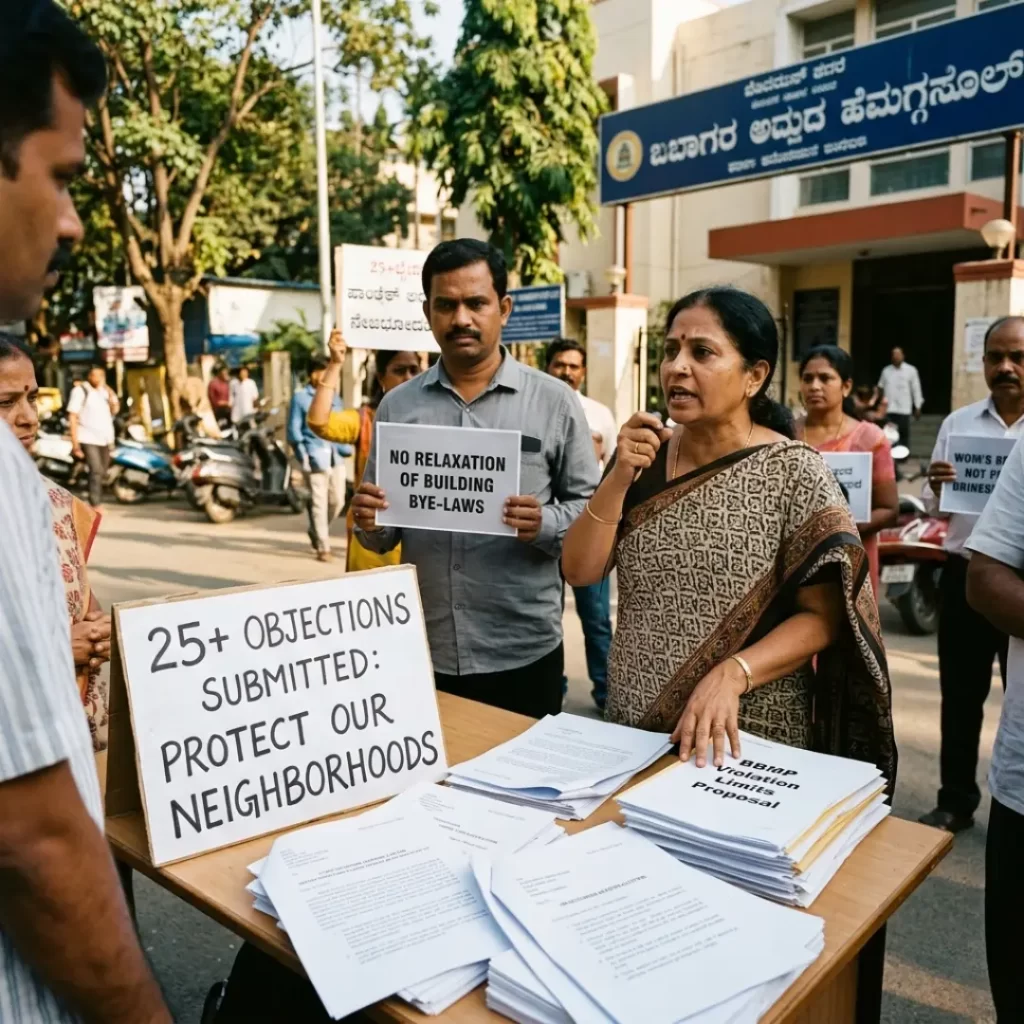
If you have ever tried to build a house, renovate a property, or even just get a basic plan sanctioned in Bengaluru, you know it presents an exhausting obstacle course. The city’s growth has been explosive, but the rules governing that expansion have often lagged behind, creating a chaotic mess for homeowners, builders, and the authorities alike. Recently, a new proposal aimed at easing the strict penalties and limits on building deviations made headlines, but it didn’t exactly receive a warm welcome. In fact, citizens submitted 25 objections over a proposal to ease building violation limits in Bengaluru.
At first glance, 25 objections might not sound like a massive public uprising. But in the context of urban planning policies, where authorities often push changes through with little public debate, these 25 submissions represent a deep-rooted frustration. They act as a warning shot from residents, urban planners, and civic activists who are tired of watching the city’s livability crumble, one illegal floor at a time.
Here at MNM Enterprises, we have navigated the construction landscape of this city for years. Our team has handled the confusing maze of approvals, dealt with the ever-changing policies, and seen firsthand how these rules impact real people trying to build their dream homes. As a construction company that believes in doing things the right way, we understand the temptation to ease the rules—building legally in Bengaluru is tough. However, we also understand the catastrophic long-term consequences of normalizing deviations.
Let’s dive deep into what these 25 Bengaluru building objections actually mean, why the government wants to change the rules, and how this affects anyone looking to build in the city today.
Understanding the Core of the Proposal
To understand the pushback, we first need to examine the proposal itself. The Bruhat Bengaluru Mahanagara Palike (BBMP) suggested relaxing the limits on building violations. Currently, if a building deviates from the sanctioned plan—say, by building too close to the boundary wall or adding extra floor area ratio (FAR) beyond what authorities permit—the law strictly penalizes the violators. In many cases, severe deviations trigger demolition notices.
The proposal for easing building violation limits Bengaluru stems from pragmatism. Officials point out that a vast majority of buildings in the city have some level of deviation. If the BBMP strictly enforced demolition on all these structures, authorities would tear down half the city. By easing the limits, the government hopes to bring these deviated buildings into the legal fold, collect hefty penalties to fill the civic coffers, and provide relief to thousands of middle-class homeowners who might otherwise lose their homes.
However, this is exactly where the Bengaluru construction regulation changes hit a wall of resistance. Objectors argue that easing limits does not solve the problem; it surrenders to it. This approach sends a dangerous message: build illegally now, pay a fine later, and your building will remain safe.
The Anatomy of the 25 Objections
Who submitted these objections, and what exactly do they say? The 25 objections came from a mix of Resident Welfare Associations (RWAs), urban planning experts, environmental activists, and concerned citizens. These groups have studied the fine print, and their concerns go far beyond simple rule-breaking.
Safety remains the primary driver behind these BBMP building bylaw amendment objections. When a builder violates setback rules, they essentially steal the space meant for light, air, and emergency access. In a dense urban environment like Bengaluru, where parked cars and cables already choke narrow lanes, reducing the mandatory setbacks makes the area practically impassable for fire trucks or ambulances. Imagine a fire breaking out in a densely packed residential area where buildings leave barely a few feet of space. Fire engines simply cannot enter, turning a manageable emergency into a devastating tragedy.
Then comes the issue of structural load. Adding extra floors without proper sanctions puts immense stress on the building’s foundation, which engineers designed for a specific load. This isn’t just a bureaucratic violation; it creates a life-threatening hazard. Soil conditions vary drastically across the city, and constructing beyond the permitted FAR without evaluating the soil’s load-bearing capacity invites catastrophic collapses.
By submitting these Bengaluru building objections, citizens point out that the city cannot afford to compromise on basic safety parameters just because enforcing the law inconveniences the authorities. Analyzing these Bengaluru building objections reveals a city at a crossroads, forcing a choice between short-term political appeasement and long-term urban survival.
The “Regularization” Trap: A Failed History
To grasp the current pushback, we must look at the past. Karnataka has a long history of trying to regularize illegal buildings through schemes like Akrama-Sakrama. The idea always revolves around levying a penalty, legalizing the deviation, and moving on.
Yet, the building regularization policy Karnataka has tried to implement in the past has failed massively. Why? Because it fundamentally violates the principles of natural justice. Why should someone who followed the rules, built within setbacks, and paid for legally permitted FAR receive the same treatment as someone who flouted the rules, maximized their plot coverage, and then simply paid a penalty?
Often, the penalty represents just a fraction of the profit the builder makes by selling the extra, illegally built floor space. It doesn’t deter anyone; it just adds a minor cost of doing business. The 25 objectors heavily lean on this historical failure. They argue that tweaking the building violation rules in Bengaluru to allow more deviations will just lead to another failed Akrama-Sakrama scheme, where the system punishes the honest taxpayer and rewards the violator. If the government sets a precedent that laws are merely suggestions negotiable for a price, respect for all civic rules gradually erodes.
The Impact on Honest Homeowners and Builders
As a company that prides itself on ethical construction, MNM Enterprises feels the sting of these policies acutely. When clients approach us, they frequently ask why we cannot just “adjust” the boundary wall a little bit or “squeeze in” an extra room. They watch their neighbors doing it without consequence, and they feel foolish for following the law.
This creates the most insidious effect of relaxing Bengaluru property violation norms: it breeds a culture of lawlessness. The honest builder loses business to the unscrupulous contractor who promises more square footage by cutting corners on setbacks and structural integrity. Law-abiding citizens end up subsidizing the chaos created by rule-breakers. They pay the same property taxes but suffer the consequences of congested streets, blocked sunlight, and strained infrastructure caused by neighboring illegal constructions.
We spend hours explaining to our clients the true value of construction approval rules Bangalore. Our team clarifies that an illegal construction might seem like a bonus today, but it morphs into a massive liability tomorrow. When homeowners try to sell the property, apply for an OC (Occupancy Certificate), or face a civic inspection, that illegal portion becomes a noose around their neck. Financial institutions increasingly refuse to mortgage properties without valid OCs, leaving the owner with an asset they cannot legally sell or leverage. We refuse to put our clients in that position, even if it means losing a project to a less scrupulous competitor.
Why Civic Activists are Digging Their Heels In
The civic objections to building law changes go beyond punishing rule-breakers; they aim to save the city’s infrastructure. Bengaluru already struggles with severe infrastructure deficits. Encroachers consume lakes, roads remain too narrow, and the drainage system overflows during every monsoon.
Every building that violates its sanctioned plan contributes to this macro-level disaster. When a structure eats into a setback, it diverts rainwater runoff onto the street instead of directing it into a designated recharge pit, worsening urban flooding. Similarly, when builders exceed the FAR, they cram more people into a localized area than the local infrastructure—water supply, sewage, and electricity—can handle. A pipe designed for ten families breaks down when fifty families use it, leading to constant sewage overflows and water shortages.
Any meaningful Karnataka urban planning rules update should prioritize making the city more resilient, not less. By easing violation limits, the BBMP essentially ignores the carrying capacity of the land. Acting as the voice of the city’s choked infrastructure, the 25 objectors declare that you cannot solve a housing crisis by building in floodplains or destroying drainage networks. The city needs strategic densification supported by upgraded infrastructure, not haphazard illegal densification that collapses the existing system.
The Economics of Violations: Who Really Benefits?
Let’s pull back the curtain on who actually profits when authorities ease building violation limits. It is rarely the middle-class homeowner. Greedy developers and the land mafia primarily benefit because they intentionally violate norms to maximize their profit margins.
A developer buys a plot, gets a plan sanctioned for, say, a ground-plus-three structure, and then builds a ground-plus-four or five structure. The extra floors generate pure profit. Whether through a regularization scheme or the easing of limits currently proposed, the developer simply pays a fraction of the profit as a penalty, and the illegal building magically becomes legal. The math is simple: the revenue from selling an extra floor far exceeds the penalty imposed by the civic body.
This explains why the 25 Bengaluru building objections hold such significance. They attempt to close this lucrative loophole. Lowering the bar for compliance provides a massive incentive for developers to keep breaking the law, knowing the government will eventually bail them out. This practice artificially inflates the real estate market, degrades the neighborhood, and leaves the end-buyer holding a structurally compromised asset.
At MNM Enterprises, we believe true value in construction stems from quality, safety, and compliance. Our team refuses to play the game of deliberate deviations. When we take on a project, our engineers and architects work meticulously to maximize the usable space within the legal boundaries. Achieving this requires more skill, more creativity, and more effort, but the result gives our clients a home they can live in with complete peace of mind.
The Legal and Environmental Implications
Beyond the moral and economic arguments, strict legal hurdles block these relaxed norms. The National Building Code of India and various Supreme Court rulings have repeatedly emphasized the importance of adhering to safety standards and setbacks.
In fact, the Supreme Court has previously struck down attempts at mass regularization of illegal constructions, stating that such moves violate the right to life, which includes the right to safe infrastructure. By proposing these regulation changes that fly in the face of judicial pronouncements, the BBMP sets the city up for prolonged legal battles. Courts have consistently held that municipal bodies cannot compromise on town planning laws merely to generate revenue through compounding fees.
Environmentally, the cost runs even higher. Bengaluru’s tree cover depletes rapidly. Setbacks do not merely provide empty spaces; they allow for planting trees, let sunlight reach the ground, and facilitate groundwater recharge. When buildings encroach into these spaces, the urban heat island effect worsens, and the groundwater table drops further. Any urban development regulations Bengaluru adopts must prioritize environmental sustainability over short-term real estate gains. The city’s infamous floods are a direct result of tampering with stormwater drains and zero setbacks, leaving rainwater with nowhere to go but into people’s homes.
Decoding the Specifics: What Do the Objections Target?
Looking closely at the 25 Bengaluru building objections, they target specific technical relaxations proposed by the BBMP.
First, setback reductions. The proposal suggested reducing the mandatory setback distances, especially for smaller sites. Objectors argue that in a city where even a 30×40 site qualifies as a luxury, every inch of setback matters for light and ventilation. Reducing it leads to suffocating, dark homes with no cross-ventilation, forcing residents to rely entirely on artificial lighting and air conditioning, which spikes electricity consumption.
Second, FAR violations. Allowing a higher percentage of deviation in the Floor Area Ratio effectively legalizes the construction of extra floors. This directly impacts the load-bearing capacity of the soil and the structural integrity of the building. It also dumps more population density into areas without proportional upgrades to civic amenities like parks or schools.
Third, parking waivers. Many violators convert the ground floor, meant for parking, into commercial spaces or apartments. By easing norms, the city essentially legalizes the practice of parking cars on the streets, choking the already narrow residential roads. This creates daily gridlock and emergency access nightmares.
The subtext of these bylaw amendment objections is clear: instead of making it easier to break the rules, the BBMP should make it harder to get away with breaking them.
The Way Forward: How Should the City Adapt?
If easing the limits fails to solve the problem, what will work? How does a city address millions of square feet of illegal construction?
Stopping the bleeding is the first step. The government needs to implement a strict, zero-tolerance policy for new constructions. Today, with satellite imagery, GIS mapping, and drones, authorities can monitor construction in real-time. The BBMP should use technology to identify deviations as they are being built, rather than discovering them years after people occupy the building. This makes the enforcement of violation rules proactive rather than reactive. Halt the illegal construction at the plinth level, and the builder has no choice but to comply.
Simplifying and de-corrupting the building approval process comes next. Often, builders violate norms because the approval process is so tedious and opaque that they prefer to build first and bribe their way out later. By making the approval process more transparent and faster, the government can remove the incentive for initial deviations. Single-window clearances, digitized plans, and strict timelines for approvals can drastically reduce the temptation to bypass the law.
Finally, for existing, older buildings with minor deviations that do not compromise structural safety or public infrastructure, authorities might consider a one-time, heavily penalized regularization—but this must be the absolute last time. Major violations that block roads, encroach on lakes, or threaten structural safety must still face demolition. Public safety cannot suffer compromise.
What This Means for You: Building Smart with MNM Enterprises
For the average person looking to build a home in Bengaluru, this ongoing tussle between the authorities and the citizens creates immense confusion. Should you follow the rules, or should you push the boundaries, hoping the rules will eventually loosen?
Our advice at MNM Enterprises is simple: Never compromise on compliance.
The 25 Bengaluru building objections have proven that the civic consciousness of the city remains awake. Citizens are watching, and they will fight to preserve the city’s livability. Any relaxation in rules is temporary; the structural risks and legal liabilities of a deviated building are permanent.
When you build with MNM Enterprises, you partner with a team that understands the law inside and out. Our focus isn’t just on constructing structures; we build legacies. Every beam, every column, and every wall sits exactly where it belongs according to the sanctioned plan. Navigating the complex web of BBMP approvals, BESCOM sanctions, and environmental clearances is our job, so you don’t have to stress over it. Ultimately, we believe that the beauty of a home lies not just in its design, but in the absolute peace of mind it delivers.
You shouldn’t have to worry about a notice from the municipal corporation just because you wanted a little extra space. Our architects achieve that extra space through smart, innovative design that works with the urban development regulations mandates, not against them. We use spatial efficiency, natural light optimization, and clever storage solutions to make a legally compliant home feel expansive and luxurious.
The Broader Message of the Objections
The submission of these 25 objections mirrors a larger battle fought across India’s growing cities. It pits short-term expediency against long-term sustainability. The government’s proposal acts as a band-aid on a bullet wound. Collecting some penalty revenue might stop the bleeding temporarily, but it does nothing to cure the underlying disease of poor urban governance.
Filing these Bengaluru building objections demonstrates a collective refusal to accept flawed urban planning. The civic objections to these changes must serve as a wake-up call for policymakers. They need to realize that the citizens of Bengaluru are not just passive consumers of real estate; they are stakeholders in the city’s future. People understand that a city which legalizes its own violations is a city planning for its own collapse.
As we look ahead, the urban planning rules update needs to prioritize safety, sustainability, and equity. It must protect the honest builder and penalize the corrupt. Infrastructure must grow in tandem with the population, rather than collapsing under its weight. Planners must integrate public transit, allocate green spaces, and enforce zoning laws strictly. Only then can Bengaluru reclaim its title as a genuinely livable metropolis.
Final Thoughts: Building a Better Bengaluru
The sheer validity of these Bengaluru building objections forces the BBMP to reconsider how they manage the city’s growth. The debate sparked by these 25 submissions is far from over. The BBMP will review the objections, deliberate on the feedback, and eventually release a revised policy. Yet the signal remains clear: citizens are challenging the free ride for building violators.
As a construction company deeply rooted in this city, MNM Enterprises stands firmly on the side of compliance and quality. We urge all prospective homeowners to resist the temptation of illegal deviations. The few extra square feet you gain today are not worth the anxiety, the legal battles, and the safety risks you will face tomorrow.
It is time to build homes that respect the boundaries of the law and the boundaries of nature. Instead of asking the authorities to lower the standards, we must demand better enforcement of property violation norms. Choosing builders who value engineering integrity over shady shortcuts is the only way forward.
Bengaluru is a city of dreams, innovation, and immense potential. To protect that potential, we must respect the framework that keeps the city standing. The 25 objectors understood this. It’s time the rest of the city—from the policymakers to the builders to the homeowners—understands it too.
When you are ready to build a home that is safe, legal, and beautifully crafted, MNM Enterprises is here to turn your vision into reality—without compromising on the rules that keep our city alive.
For More Visit: https://mnmenterprises.ltd/
Planning to buy flats in bangalore Contact : www.globesproperties.com