Construction

Pre-launch property vs new-launch property comparison by MNM Enterprises

Pre-Launch Property vs New-Launch Property: Key Differences

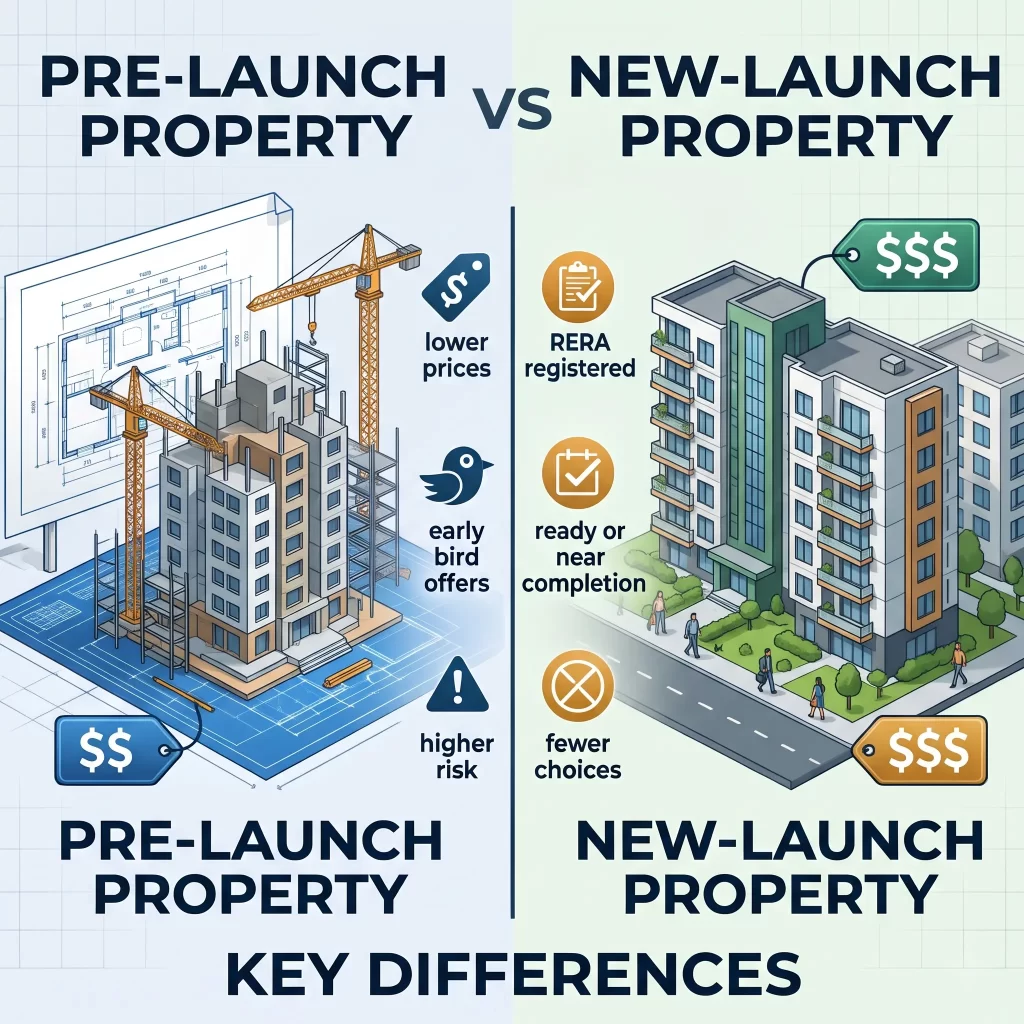
If you have been house-hunting in Bangalore recently, you have probably heard agents throw around terms like “pre-launch” and “new-launch” as if everyone knows what they mean. Most buyers nod along, then quietly Google the terms later. That’s completely normal, and it’s exactly why we wrote this guide. The pre-launch property vs new-launch property debate is one of those things that sounds technical until someone explains it plainly, and then it clicks. Here’s the short version: these two words describe different stages of a project’s life. Where you buy in decides how much you pay, how long you wait for the keys, and how much risk you carry along the way. There’s no universal “better” option, only the one that fits your life right now. In the sections ahead, the team at MNM Enterprises walks you through what each stage means, how they differ, and how to pick the one that actually suits you. Pre-Launch Property Meaning: What This Stage Really Means Let’s clear up the pre-launch property meaning first, because it’s the one that confuses people the most. Pre-launch is the earliest point at which a builder opens a project for booking, often before every regulatory approval is in place. Think of it as the developer saying, “Here’s what we’re planning to build. If you commit now, you get the best price we’ll ever offer.” You’re essentially buying into the promise of a project, not the finished product. That promise comes with trade-offs. The price is genuinely attractive, often the lowest you’ll ever see for that project. But you wait longer, sometimes three to five years, and you accept that approvals, layouts, or handover dates could shift. Buyers often ask us at MNM Enterprises whether pre-launch bookings are safe. The honest answer: they can be, if the builder has a solid track record and is transparent about where the approvals stand. Pre-launch rewards patience and trust in the developer’s execution. New-Launch Property Meaning: What You Should Know Now for the new-launch property meaning. A new-launch project has cleared every regulatory hurdle and is officially open for sale, with construction either just starting or about to. The paperwork is sorted, the layout is locked in, and the builder is ready to break ground. Prices have usually moved up a notch from the pre-launch level, but you’re still getting in early enough to enjoy competitive rates and a good choice of units. For a lot of buyers, this stage hits the sweet spot. You’re not paying the premium of a ready-to-move-in home, and you’re not shouldering the uncertainty of a pre-launch booking. The developer has already shown commitment by securing approvals, which gives you something concrete to plan around. Our advice at MNM Enterprises is the same regardless of stage: verify the approval status, the timeline, and the builder’s past delivery record before you commit a single rupee. Difference Between Pre-Launch and New-Launch Property Four Factors That Shape the Comparison So how do you actually compare pre-launch property vs new-launch property without getting lost in jargon? The difference between pre-launch and new-launch property really boils down to four things: regulatory status, pricing, timeline, and risk. Get your head around those four, and the rest of the decision falls into place. Regulatory Status and Approvals This is the big one. Pre-launch projects haven’t received all their regulatory approvals yet. New-launch projects have. Almost every other difference, from price to risk, traces back to this single point. Pricing and Payment Structure Pre-launch prices typically sit 15 to 25 percent below new-launch prices for the same project. That discount is your reward for taking on early risk. New-launch prices are higher, but you’re paying for certainty, and most buyers find that premium worth it. Project Timeline Pre-launch means a long wait, usually three to five years before you get the keys. New-launch projects run on shorter, more predictable timelines because the approvals are already through. If you need a home in the next year or two, new-launch is realistically your only option of the two. Risk Profile Pre-launch carries real risk: approval delays, layout changes, even the rare project cancellation. New-launch strips most of that away because the regulatory framework is already locked in. Lower risk, lower drama. Pre-Launch vs New-Launch Flats: A Practical Comparison Matching the Stage to Your Personal Situation When you narrow the pre-launch property vs new-launch property choice down to flats, the decision usually comes down to your life situation. Picture a 28-year-old software engineer with a stable job and no urgent need to move. For them, a pre-launch flat can be a fantastic wealth-building move, lock in a low price, wait three to four years, and watch the value climb. Now picture a family with a toddler and a lease ending in ten months. They almost certainly need a new-launch or ready-to-move option. The pre-launch vs new-launch flats comparison also feeds into financing. Banks approve home loans more readily for new-launch projects because the approvals reduce their lending risk. Pre-launch bookings can mean a larger upfront commitment and a more patient approach to loan disbursement. At MNM Enterprises, we’ve delivered both kinds of projects across Bangalore, and if there’s one thing we’ve learned, it’s this: there’s no one-size-fits-all answer. The right call depends on your timeline, your finances, and how much uncertainty you can live with. Benefits of Pre-Launch Properties Why Buyers Choose Pre-Launch Property vs New-Launch Property In the pre-launch property vs new-launch property discussion, pre-launch wins on one thing above all: price. The benefits of pre-launch properties start with the lowest purchase price you’ll ever see for that project, which often translates into real capital appreciation by handover day. You also get first pick of premium units and floor plans before they’re gone, plus flexible payment plans that follow construction milestones instead of demanding everything upfront. Pre-launch property investment works beautifully for buyers who don’t need to move in immediately and who have the financial flexibility to wait. That long timeline can actually work in your

Pre-Launch Property vs New-Launch Property: Key Differences Read More »

Property price negotiation tips with builders in Bangalore by MNM Enterprises

How to Negotiate Property Prices with Builders in Bangalore

Introduction: Master the Art of Builder Negotiation Property price negotiation tips are essential for anyone buying a home in Bangalore’s competitive real estate market. Naturally, builders quote the highest possible price first. However, almost every quoted price has room for negotiation built in. In fact, knowing how to negotiate property prices in Bangalore can save you anywhere from Rs 5 lakh to Rs 20 lakh on a single property. Therefore, this guide from MNM Enterprises walks you through proven Property price negotiation tips used by seasoned buyers. Specifically, we cover negotiating property prices with builders — timing, leverage points, common mistakes, and the exact scripts to use. Ultimately, the goal is simple: help you walk into a builder’s office with confidence and walk out with a better deal. Why Builders Expect You to Negotiate in Bangalore The Hidden Margin in Every Quoted Price First, builders in Bangalore almost always pad their initial quote by 8–12%. Indeed, this padding covers marketing overheads, broker commissions, and the inevitable negotiation discount. Consequently, the brochure price is rarely the final price. As a result, expecting to pay sticker price is the first mistake new buyers make. Why Builders Prefer Ready Buyers Over Marginal Gains Furthermore, builders prefer a quick sale over squeezing out the last rupee. For example, a builder would rather close a deal today at a 5% discount than wait three months for a full-price buyer. Therefore, your seriousness as a buyer is your strongest leverage. Above all, demonstrate that you can close quickly, and discounts will follow. Property Price Negotiation Tips That Actually Work Tip 1: Never Reveal Your Maximum Budget First and foremost, never tell the builder your true maximum budget. In fact, the moment you share your upper limit, negotiations end right there. Instead, quote a price 15–20% below your actual ceiling. Therefore, even after some back-and-forth, you stay within budget while the builder feels they won. Tip 2: Research Five Comparable Projects Before Walking In Next, research at least five similar projects in the same micro-market before visiting. Specifically, note their per-square-foot prices, amenities, and possession timelines. Armed with this data, you can say: “Builder X is offering at Rs 6,200 per sq ft with similar amenities.” Consequently, the builder knows you have done your homework. As a result, they take you seriously. Tip 3: Use the “Walk Away” Tactic Strategically Another powerful tactic is the strategic walk-away. Of course, this works only if you are genuinely willing to leave. After hearing the first quote, simply say: “Thank you, but this is beyond my budget. I will explore other projects.” Surprisingly often, the builder calls you back within 48 hours with a better number. Tip 4: Negotiate Per-Square-Foot, Not Just Total Price Moreover, always negotiate on the per-square-foot rate rather than just the total price. For instance, a Rs 100 reduction per sq ft on a 1,200 sq ft apartment saves Rs 1.2 lakh upfront. Therefore, this single lever often unlocks the biggest savings. Indeed, builders are more flexible here than on the total amount. Tip 5: Ask for Freebies Instead of Just Price Cuts Finally, when the builder refuses further price cuts, switch to freebies. For example, request free covered car parking, a modular kitchen, or waived maintenance for two years. Additionally, ask for free club membership or reduced society deposit. Together, these can add up to Rs 4–6 lakh in real value. Best Time to Negotiate Property Prices in Bangalore Quarter-End and Financial Year-End Pressure Importantly, the timing of your offer matters as much as the offer itself. Specifically, builders face immense pressure to close sales at quarter-end and financial year-end. For instance, March is a golden window because builders want to show strong numbers to investors. As a result, the last two weeks of March often unlock the deepest discounts. Project Launch Phase vs Ready-to-Move-In Phase Furthermore, the project phase shapes your leverage. During the pre-launch or soft-launch phase, builders offer the lowest rates to attract early buyers. Conversely, ready-to-move-in units carry premium pricing. However, the last few units of a completed project are often discounted to close the project officially. Therefore, both phases have their own negotiation sweet spots. Slow Market Months: Your Hidden Advantage Also, the months of June–August typically see slower sales in Bangalore. During this period, builders are more open to negotiation. Moreover, festival seasons like Diwali bring advertised “discounts” that are mostly cosmetic. Instead, the real savings happen during the lean months when genuine pressure builds. How to Negotiate Flat Prices with Builders in Bangalore The Pre-Launch Booking Window First, the pre-launch booking window is the sweetest spot for Property price negotiation tips to work in your favour. Specifically, builders offer “early bird” rates that are 10–15% lower than launch prices. Furthermore, you can often negotiate further within this window. Indeed, this is where the best deals in Bangalore are quietly made. The Inventory Clearance Phase Additionally, when a project is 85–90% sold, the builder wants to close the project officially. Consequently, the last 10–15 units are often discounted by 5–8%. Moreover, you can negotiate hard on these because the builder’s interest cost on unsold inventory is high. As a result, you win, and they free up capital. Group Booking and Referral Leverage Equally powerful is the group booking approach. For instance, if you and three friends book together, the builder sees four guaranteed sales. Therefore, they are often willing to offer a 3–5% group discount. Similarly, if you refer another buyer after your booking, you can ask for a referral discount on your unit. Builder Negotiation Strategies for Bigger Discounts Use Competitor Quotes as Leverage First among Builder negotiation strategies is using competitor quotes. Specifically, collect official quote letters from two or three competing builders. Then, share these with your preferred builder and ask them to match. In fact, builders hate losing a serious buyer to a competitor. As a result, they often match or beat the rival quote. Highlight Your Serious Intent Without Desperation Moreover, demonstrate seriousness

How to Negotiate Property Prices with Builders in Bangalore Read More »

How to calculate rental yield for properties in Bangalore with MNM Enterprises

How to Calculate Rental Yield on a Property in Bangalore

Let’s be honest — nobody buys a Bangalore flat for the romance of it. You buy it because you want the rent to cover the EMI, or at least come close. That’s where learning how to calculate rental yield comes in. It’s a five-minute maths trick that separates a flat that pays you back from one that quietly drains your wallet. Rental yield on property in Bangalore is the single number most buyers skip, and most regret skipping. At MNM Enterprises, we walk every single customer through it before they sign anything. This guide breaks it down the way we’d explain it to a friend over filter coffee — no jargon, no spreadsheets, just clarity. User Intent: Why People Search for Rental Yield If you’re reading this, you’re probably not after a textbook definition. You’re at one of those moments where a number would actually help. Maybe you’ve shortlisted a 2-BHK in Whitefield and you want a sanity check before the booking amount leaves your account. Maybe you’re torn between two localities and need something objective to break the tie. Or you’ve just sold an older flat and you’re weighing real estate against mutual funds. All three intentions boil down to the same thing. You want to turn a gut-feel decision into a number you can defend at the dinner table. Real estate investment in Bangalore is a multi-crore commitment now. A repeatable way to estimate return isn’t optional anymore — it’s basic hygiene. What Is Rental Yield and Why It Matters Rental yield is just your annual rent, written as a percentage of the property’s value. A flat worth Rs 1 crore that earns Rs 4 lakh in rent per year? That’s a 4% yield. Simple as that. What makes it powerful is that it compresses a dozen messy variables — location, demand, tenant quality, maintenance, vacancy — into one number you can compare. Knowing how to calculate rental yield lets you line up a Bangalore apartment against a fixed deposit, a debt fund, or a commercial office on the same yardstick. Without this single calculation, property investment returns in Bangalore become a guessing game driven by what your cousin’s brother-in-law heard from a broker. And that’s how people end up funding their flats instead of earning from them. How to Calculate Rental Yield: The Core Formula Here’s the rental yield formula for real estate in plain English. Take your annual rent, divide it by the property’s market value, multiply by 100. That’s it. Quick example. A 2-BHK in Whitefield costs Rs 80 lakh. It rents for Rs 30,000 a month, which is Rs 3,60,000 a year. Divide 3,60,000 by 80,00,000 — you get 0.045, or 4.5% gross yield. Once you know how to calculate rental yield on a property, you can run the same logic on a studio in Indiranagar, a villa in Devanahalli, or a commercial space on MG Road. Most people stop at the gross number. The honest answer is the net one, which we’ll come to in a bit. And honestly, this is the calculation our sales advisors at MNM Enterprises do with every buyer on day one. Not because it’s clever, but because it’s honest. Once you understand how to calculate rental yield, you’ll see why two flats with the same price tag can give you very different returns. Rental Yield Calculation in Bangalore: Local Factors Bangalore isn’t one market — it’s a patchwork of micro-markets, each with its own rent ceiling and tenant mix. A proper rental yield calculation in Bangalore has to factor in three local realities, or you’ll buy a ‘deal’ that flops on the ground. IT Corridors Pay More, But Cost More Places like Whitefield, Electronic City, and Sarjapur Road command higher rents per square foot. Tenants pay for the commute they save. But entry prices are higher too, so the percentage yield often matches cheaper zones. The upside is lower vacancy and stronger tenant demand. Peripheral Zones Look Cheaper, but There’s a Catch Devanahalli, Bommasandra, and similar edges offer lower ticket sizes and proportionally lower rents. The percentage can match the IT corridors. But tenant demand is thinner, and exits take longer. Fine if you’re patient. Painful if you’re not. City Averages Hide the Truth The average rental yield in Bangalore for ready-to-move-in apartments sits between 2.8% and 3.8%. Pockets close to tech parks can touch 4% and above. Don’t trust a city-wide number. Always run the maths for the specific pin code you’re buying into. Rental Income Calculation for Property: Beyond the Basic Formula Gross yield is the headline. Net yield is the truth. A real rental income calculation for property subtracts what it costs you to own the place before telling you what’s left. For a typical Bangalore apartment, expect annual maintenance of Rs 25,000 to 60,000. Property tax runs Rs 8,000 to 20,000. Keep one month’s rent aside as a repair reserve. And budget a 5 to 10% vacancy buffer for the gap between tenants. So if your Rs 30,000 rent shrinks to Rs 24,000 in your hand, your real yield falls from 4.5% gross to about 3.6% net. That’s the number to think about, not the brochure figure. Once you know how to calculate rental yield at the net level, you can compare flats like-for-like and stop falling for headline rent. For rental income from flats in Bangalore, June (joining cohort of IT folks) and December (year-end moves) are when you’ll see the strongest demand. Underwrite conservatively — the money you don’t assume is the money you don’t miss. Property Investment Returns in Bangalore: What to Expect Set realistic expectations before you set your heart on a yield. Across the city, the average rental yield in Bangalore for residential property sits between 3% and 4%. Some new micro-markets nudge 4.5%. Luxury enclaves often dip below 2.5%. Honestly, residential property rental returns in Bangalore look modest on cash flow alone. Commercial office yields 7 to 9%, retail 5 to 7%. But residential wins on three

How to Calculate Rental Yield on a Property in Bangalore Read More »

Carpet Area vs Built-Up Area explained by MNM Enterprises

Carpet Area vs Built-Up Area vs Super Built-Up Area Explained

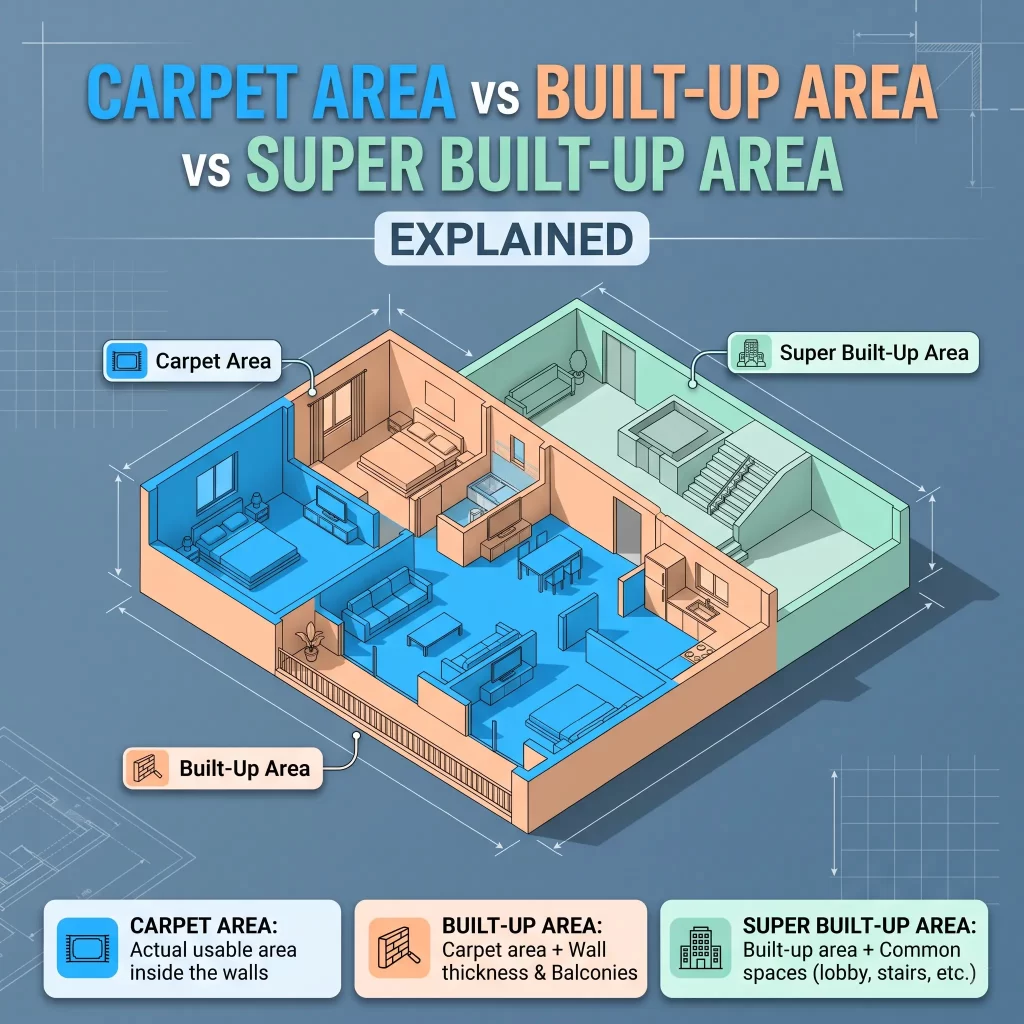
Why Carpet Area vs Built-Up Area Confuses Bangalore Buyers When you walk into a sample flat in Bangalore, the salesperson often quotes a glamorous “1200 sq ft” figure. It looks perfect on paper. However, the moment you receive the sale deed, that number shrinks to 850 sq ft. What just happened? You have just met the three faces of apartment measurement: carpet area, built-up area, and super built-up area. For anyone buying an apartment in Bangalore, knowing the difference is not optional. In fact, it is the line between getting what you paid for and paying for someone else’s lobby. At MNM Enterprises, we believe transparency begins with clarity. Therefore, this guide breaks down Carpet Area vs Built-Up Area vs Super Built-Up Area in plain language. Furthermore, we walk you through the RERA carpet area Bangalore rules, and show you exactly how to calculate flat area in Bangalore before signing anything. What Is Carpet Area? Carpet Area vs Built-Up Area: The Usable Space Inside Carpet area is the actual usable floor space inside the apartment. In other words, it is the area on which you can literally roll out a carpet. It includes bedrooms, living room, kitchen, bathrooms, balconies, and internal partition walls. However, it excludes the thickness of external walls, common areas, lift lobbies, and ducts. RERA defines carpet area as the net usable floor area of an apartment. This excludes external walls, service shafts, exclusive balcony/verandah area, and exclusive open terrace area. This is the number that matters most. After all, this is the space you actually live in. If you are examining apartment carpet area in Bangalore, expect it to be roughly 70% of the super built-up area in older projects. In premium high-rises, it shrinks to 60–65% because lobbies and amenities eat into your share. At MNM Enterprises, every project brochure clearly displays the carpet area alongside the super built-up figure. As a result, buyers never have to guess what they are paying for. What Is Built-Up Area? Beyond Carpet Area vs Built-Up Area: Walls and Balconies Built-up area is the carpet area plus the thickness of external walls, internal partition walls, and the balcony/terrace attached to the apartment. In simple terms, it is the area enclosed by the apartment’s outer boundary. Typically, built-up area is 10–15% larger than the carpet area. For example, if an apartment has a carpet area of 700 sq ft, its built-up area may be around 820 sq ft. Many developers quote built-up area to make the apartment appear larger. Nevertheless, RERA now mandates that pricing must be based on carpet area, not built-up or super built-up. This is one of the most important points in the Carpet Area vs Built-Up Area debate. Simply put, what you see on the brochure is not always what you pay for. What Is Super Built-Up Area? Where Carpet Area vs Built-Up Area Meets Common Amenities Super built-up area is the built-up area plus a proportionate share of common areas. These include lift lobbies, staircases, clubhouses, corridors, gymnasiums, swimming pools, security cabins, and other shared amenities. This is the figure most aggressively marketed as the “saleable area.” Consequently, it can be 25–40% larger than the carpet area, depending on the project’s amenity load. The proportion added is called the loading factor. For instance, if a builder quotes 1200 sq ft super built-up with 30% loading, the actual carpet area is around 840 sq ft. This is exactly why Carpet Area vs Built-Up Area discussions almost always circle back to super built-up area. Ultimately, it is the figure that creates the biggest gap between expectation and reality for a buyer. Carpet Area vs Built-Up Area: The Real Difference Carpet Area vs Built-Up Area in Plain Numbers Understanding Carpet Area vs Built-Up Area is the cornerstone of smart home-buying. Carpet area is the space you actually walk on, sleep in, and place your furniture. By contrast, built-up area is the carpet area plus the walls around it. Super built-up area, meanwhile, throws in everyone’s shared spaces too. When comparing Carpet Area vs Built-Up Area, the practical takeaway is simple. Ask for all three figures in writing, but base your buying decision on the carpet area alone. Many first-time buyers confuse the three. As a result, they end up paying for amenities as if they were private living space. The Carpet Area vs Built-Up Area gap is where builders traditionally made their margin. They quoted a large super built-up number and a small loading percentage. Under RERA, this practice is no longer legal. Yet it still happens in non-RERA-registered plots, agricultural-layout conversions, and resale transactions where the original sale deed predates RERA enforcement. Therefore, when navigating these area measurements, the rule of thumb is simple. If a number looks too good for the price, ask what it actually includes. In addition, ask for it in writing, and ask for the RERA registration number that backs it up. A genuine builder will answer all three questions without hesitation. Conversely, a builder who hesitates is one you should walk away from. How to Calculate Flat Area in Bangalore Flat Size Calculation Bangalore Buyers Can Trust Flat size calculation Bangalore buyers can trust begins with three simple formulas. Master these, and you will never again be fooled by a brochure that promises 1200 sq ft and delivers 820: To calculate the loading factor, use this formula: (Super Built-Up Area − Carpet Area) ÷ Carpet Area × 100. If the result exceeds 35%, the project has high loading. Therefore, you are paying heavily for shared amenities. If you want to know how to calculate flat area in Bangalore, ask the builder for the RERA registration number first. Once you have it, visit the RERA Karnataka portal and look up the project. Then, verify the carpet area quoted in the sale agreement against the carpet area filed with RERA. Any mismatch is a red flag. At MNM Enterprises, our sales team walks every client through this calculation live, on a printed sheet,

Carpet Area vs Built-Up Area vs Super Built-Up Area Explained Read More »

Buying land in Bangalore legal document checklist by MNM Enterprises

Buying Land in Bangalore: Legal Documents and Verification Checklist

1. Buying Land in Bangalore: Why Legal Verification Comes First Buying land in Bangalore is the single biggest financial decision most first-time buyers ever make. Therefore, legal verification must come before any token payment, before any site visit, and before any emotional commitment to a plot. Moreover, the city’s rapid expansion has pushed land values to record highs. As a result, the temptation to close quickly often overrides careful due diligence. However, that one shortcut can later translate into years of litigation, demolition notices, or denial of bank loans. At MNM Enterprises, we have spent years guiding first-time buyers through this exact journey. Consequently, the most common mistake we see is buyers trusting an agent’s verbal assurance without independently verifying the title chain. Who This Guide Is For We have written this guide specifically for working professionals aged 28 to 45. Furthermore, it is designed for buyers purchasing their first plot for residential construction. In addition, the language stays practical rather than legalistic. Above all, by the end of this article, you will know exactly which documents to demand. You will also learn which approvals to validate, how much stamp duty to budget, and how MNM Enterprises can step in to make the entire process safer and faster. 2. Residential Plots in Bangalore: Why Demand Keeps Rising Three Forces Driving the Boom Three converging forces drive the demand for Residential plots in Bangalore. First, IT corridors expand steadily along Outer Ring Road, Sarjapur, Whitefield, and Electronic City. Second, the second wave of metro lines connects previously distant suburbs to the city centre. Third, working professionals migrate consistently from across India. As a result, they eventually want to own a piece of land rather than rent indefinitely. Consequently, plotted development has outperformed apartment investments on a five-year horizon. This is especially true in zones that experts considered fringe just a decade ago. Why Plots Outperform Apartments From an investment standpoint, Real estate investment in Bangalore plots has consistently delivered 8 to 14 percent annualised appreciation in approved layouts. In particular, select North Bangalore micro-markets have crossed 18 percent in the past three years alone. Moreover, unlike apartments, plots do not depreciate with age. They also carry no recurring maintenance costs. In addition, they offer the flexibility of constructing on your own timeline. Furthermore, plots escape the rental management hassles that apartment investors routinely face. Therefore, NRIs and long-term holders find them especially attractive. Where to Buy: Three Growth Axes The Best locations to buy land in Bangalore today cluster along three growth axes. Specifically, these include the North Bangalore airport corridor, the South-East Sarjapur-Attibele belt, and the West Bangalore Tumkur Road industrial zone. Among these, North Bangalore has emerged as the strongest growth story. The reason is simple: the Kempegowda International Airport expansion, the upcoming Business Bay, and the planned Peripheral Ring Road will dramatically cut commute times. Therefore, the remainder of this guide focuses heavily on North Bangalore. After all, that is where MNM Enterprises sees the most favourable risk-reward ratio for first-time buyers in 2025 and 2026. 3. Land for Sale in North Bangalore: Why It Is Strategic From Quiet Suburb to Growth Corridor North Bangalore has transformed from a quiet suburban stretch into the city’s most ambitious growth corridor. For instance, Hebbal, Yelahanka, Devanahalli, Thanisandra, and Hennur now host a dense ecosystem of IT parks, hospitality projects, educational institutions, and high-end residential villa communities. For first-time buyers, this concentration of infrastructure spending makes Land for sale in North Bangalore a compelling proposition. Specifically, it offers the rare combination of proximity to the airport, access to the metro phase 2B extension, and pricing that remains 25 to 40 percent below comparable southern micro-markets. Micro-Market Snapshot Within this corridor, several zones dominate the trade in Residential land in North Bangalore. Yelahanka and Devanahalli attract buyers prioritising BDA-approved layouts. Thanisandra and Hennur serve buyers seeking DTCP-approved villa plot communities. Meanwhile, Hebbal appeals to buyers comfortable with premium pricing in exchange for immediate livability and connectivity. Each micro-market has a distinct approval regime, price point, and appreciation trajectory. Consequently, a one-size-fits-all approach rarely works here. What MNM Enterprises Checks First When Buying land in North Bangalore, our advisory team at MNM Enterprises checks three factors. First, we verify the layout’s approval authority — BDA, BBMP-Anekal, or DTCP. Second, we assess the proximity to announced or under-construction infrastructure. Third, we evaluate the quality of the access road. Many buyers assume that any plot near the airport is automatically a good buy. However, we routinely see unapproved layouts adjacent to high-demand zones. These plots cannot be registered or financed. Therefore, Buying land in Bangalore — and especially in the North corridor — demands the same legal rigour you would apply to any major asset purchase. Above all, do not let an attractive price override your legal due diligence. 4. BDA-Approved Plots in Bangalore vs DTCP-Approved Plots in Bangalore What BDA Approval Means Bangalore has two primary approval authorities for plotted developments. Therefore, understanding the difference is essential before you commit to any property. BDA-approved plots in Bangalore fall under the Bangalore Development Authority. The BDA plans and approves layouts within its direct jurisdiction. In addition, BDA approvals involve rigorous compliance with infrastructure, road width, park allocation, and civic amenenity norms. As a result, banks readily finance BDA plots, and resale liquidity generally runs higher. In short, BDA approval is the gold standard. What DTCP Approval Means DTCP-approved plots in Bangalore, on the other hand, fall under the Directorate of Town and Country Planning. These plots typically sit outside the BDA’s direct jurisdiction, often in the city’s peripheral and rural-to-urban conversion zones. DTCP approval is perfectly legal and bankable. However, it requires the same scrutiny as BDA approval. In particular, you must confirm the layout plan has been formally sanctioned. You must also verify the conversion order from agricultural to non-agricultural use, and the developer has obtained the requisite NOCs. When MNM Enterprises vets a DTCP property, we treat the approval as valid provided

Buying Land in Bangalore: Legal Documents and Verification Checklist Read More »

How to buy a flat in Bangalore with MNM Enterprises

How to Buy a Flat in Bangalore: Documents, Costs and Checklist

1. Introduction Buying a flat is one of the biggest financial decisions you will ever make. Therefore, knowing exactly how to buy a flat in Bangalore can save you lakhs of rupees. Moreover, it can save you years of regret. Bangalore’s real estate market is fast-paced. In addition, it is layered with legal, financial, and construction-related details. As a result, first-time buyers often feel lost. 1.1 Why This Guide Exists At MNM Enterprises, we are a construction company. In other words, we build the homes you live in. Consequently, we understand the journey from the foundation upward. This guide is written from that inside perspective. Specifically, it covers the documents required to buy a flat in Bangalore, the true cost of buying a flat in Bangalore, and a practical flat buying checklist you can actually use. Whether you are purchasing your first home or your fifth, this article will walk you through the entire property buying process in Bangalore. Furthermore, it will help you avoid the most common pitfalls that drain money and peace of mind. 2. Understanding the Home Buying Process in Bangalore 2.1 The Big Picture The home buying process in Bangalore can be broken into five clear stages. First, you shortlist locations and projects. Second, you verify legal documents. Third, you arrange financing. Fourth, you register the property. Finally, you take possession. Each stage has its own checkpoints. Therefore, missing any of them can lead to costly mistakes. 2.2 Why the Order Matters Many buyers reverse the order. For instance, they finalize a flat first and then arrange the loan. As a result, they often miss good deals. Alternatively, they skip legal verification and lose the booking amount. Therefore, always follow the sequence outlined above. In fact, a single skipped step can delay possession by months. When you understand how to buy a flat in Bangalore step-by-step, the entire journey feels less overwhelming. Moreover, you gain the confidence to negotiate. After all, knowledge is your strongest bargaining tool. 3. Documents Required to Buy a Flat in Bangalore Paperwork is the backbone of every property deal. Therefore, the documents required to buy a flat in Bangalore deserve your full attention. Below is a complete list of legal documents for buying a flat. As a construction company, MNM Enterprises insists on these checks for every project we deliver. 3.1 Title and Ownership Documents 1. Sale Deed (or Agreement of Sale) — This is the primary ownership document. Specifically, it transfers title from seller to buyer. Therefore, it must be registered at the Sub-Registrar’s Office. 2. Mother Deed / Parent Deed — This traces the property’s ownership history. Moreover, it establishes that the seller has a clear chain of title. Hence, review it with a lawyer. 3. Katha Certificate & Extract (BBMP/BMRDA) — Essential for properties within BBMP limits. In fact, no property tax can be paid without it. 3.2 Approvals and Compliance 4. RERA Registration Certificate — Mandatory for all projects above 500 sq m or 8 units. Therefore, verify the registration number on the RERA Karnataka portal before booking. 5. Building Plan Sanction (BBMP/BDA) — Confirms the building is constructed legally. Moreover, deviations beyond 5% can be demolished. 6. Occupancy Certificate (OC) & Completion Certificate (CC) — Critical for ready-to-move flats. In fact, without an OC, banks may refuse home loans. 3.3 Encumbrance, Tax & Utility 7. Encumbrance Certificate (EC) — Proves the property is free of loans or mortgages. Additionally, it must cover the past 15 years. 8. Latest Property Tax Receipts — Confirms the seller has paid all dues. Otherwise, the liability passes to you. 9. No Objection Certificates (NOCs) — Required from the Fire Department, BWSSB, BESCOM, and Airport Authority (if applicable). 10. Khata Transfer Application — After registration, you must transfer the khata to your name. Consequently, this is essential for future resale. When you understand how to buy a flat in Bangalore with the right paperwork, you protect yourself from fraud. Moreover, you also make future resale easier. After all, a clean paper trail is the foundation of a stress-free ownership experience. 4. Cost of Buying a Flat in Bangalore The advertised price is rarely the final price. Therefore, knowing the true cost of buying a flat in Bangalore helps you budget accurately. Below is a breakdown of every cost component you will encounter. 4.1 Base Price & Add-ons Base Price — This is the per-square-foot price quoted by the builder. Typically, it ranges from ₹4,500 to ₹12,000 per sq ft, depending on location. GST — For under-construction flats, GST is 1% for affordable housing and 5% for others. However, ready-to-move flats attract zero GST. Preferential Location Charges (PLC) — Premium for corner flats, park-facing units, or higher floors. Consequently, this can add ₹50,000 to ₹3 lakh to your cost. 4.2 Statutory Charges Stamp Duty — Currently 5% of the property value in Bangalore. Therefore, for a ₹60 lakh flat, this is ₹3 lakh. Registration Charges — 1% of property value, capped at ₹5 lakh. Together, these are the flat registration charges in Bangalore you must budget for. Stamp Duty for Flat Registration in Bangalore — This includes stamp paper, franking, and e-stamping. Moreover, it must be paid before registration. 4.3 Other Costs Maintenance Deposit — Usually ₹50–100 per sq ft as a one-time deposit. Additionally, monthly maintenance is ₹2–4 per sq ft. Home Loan Processing Fee — 0.25% to 0.50% of the loan amount. However, some banks waive this during festive seasons. Legal & Documentation — ₹10,000 to ₹30,000 for lawyer verification and deed drafting. Interior & Furnishing — Budget 10–15% of property value. Otherwise, you will be stretched thin after possession. In total, statutory charges and add-ons add 8–12% to the base price. For instance, a ₹60 lakh flat can cost ₹65–67 lakh all-inclusive. As a result, plan your budget for the total cost, not just the sticker price. Knowing these figures is a critical part of how to buy a flat in Bangalore without surprises. Moreover, when you sit

How to Buy a Flat in Bangalore: Documents, Costs and Checklist Read More »

Step-by-step house construction process in Bangalore by MNM Enterprises

House Construction Process Step by Step in Bangalore

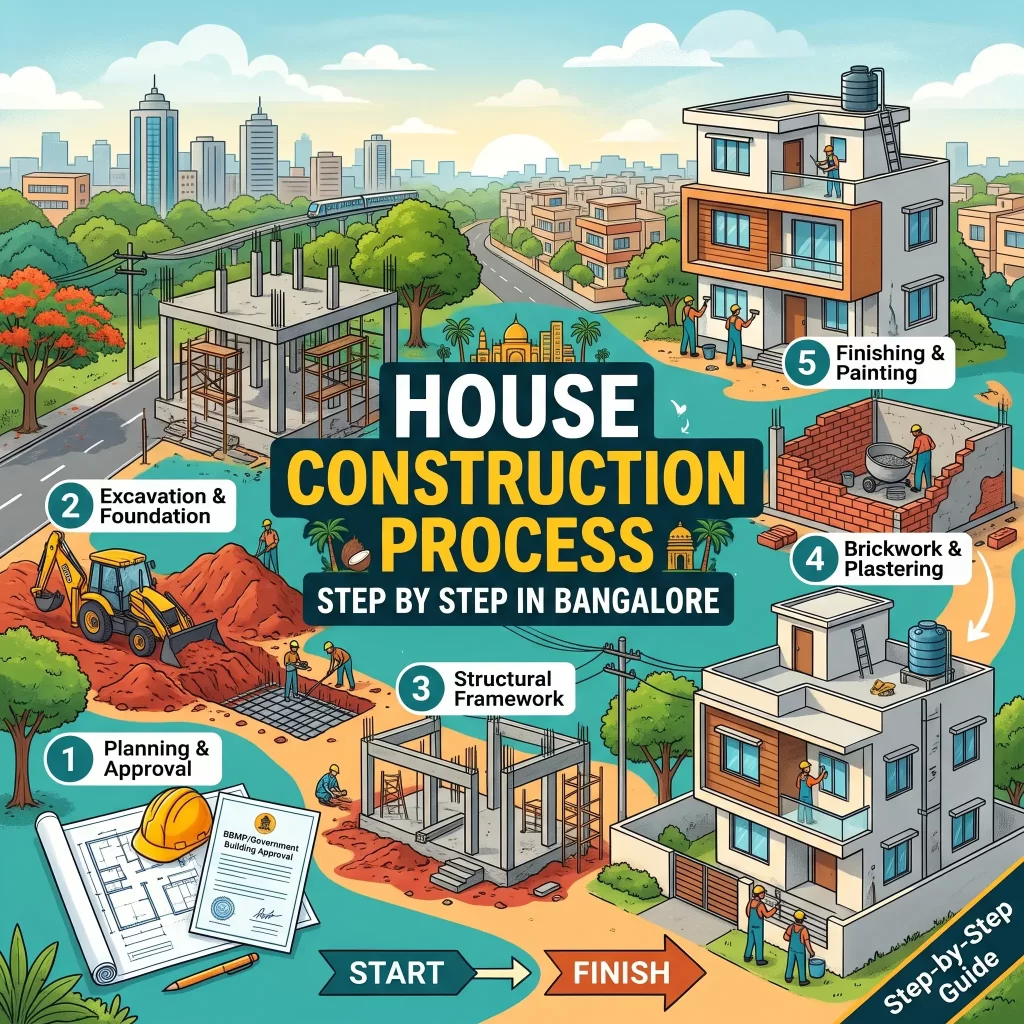
Building your own home in Bangalore is exciting. However, the Step-by-step house construction process can feel overwhelming at first. Approvals, materials, contractors, technical terms – it’s a maze. That’s completely normal. At MNM Enterprises, we’ve guided hundreds of families through this exact journey. Fortunately, here’s the good news: once you understand the stages, everything becomes far less intimidating. The House construction process in Bangalore has its own rhythm. For example, you’ll deal with BBMP approvals, local soil conditions, and monsoon-ready foundations. You’ll also navigate a busy materials supply chain. Whether you’re building a compact G+1 home or a villa, knowing each stage helps. Specifically, you’ll ask better questions. Moreover, you’ll spot problems early. As a result, you’ll stay in control of your budget. In this guide, we walk you through every stage, the costs, and the most common questions first-time builders ask us. Step-by-Step House Construction Process: An Overview Before we dive in, let’s look at the big picture. A typical residential construction process in Bangalore moves through nine stages. First, it starts with pre-construction planning. Finally, it ends with a handover. Each stage depends on the one before it. Therefore, skip a step, and you’ll pay for it later in delays or rework. Think of the stages of house construction as a relay race. The planning team hands off to the excavation team. Then they pass the baton to the foundation crew. After that, RCC and masonry teams took over. When one stage slips, the whole timeline shifts. That’s why a clear Step-by-step house construction process is so valuable. Indeed, you can see the dependencies. Also, you can plan materials in advance. Consequently, you avoid those dead weeks where nothing happens on site. Here’s the list we’ll cover. First, pre-construction planning and approvals. Second, site preparation and foundation. Third, the RCC framework. Fourth, brickwork and masonry. Fifth, plastering. Sixth, flooring, plumbing, and electrical. Seventh, finishing and fixtures. Eighth, quality check and handover. Finally, we’ll cover Bangalore construction costs. Let’s dive in. Stage 1: Pre-Construction Planning & Approvals This is where the magic – and the paperwork – begins. Before a single brick is laid, you need three things. First, your design. Second, your permissions. Third, your budget. Skip any of these, and you’ll pay for it later. Soil testing comes first. Bangalore’s soil varies dramatically. For instance, Yelahanka and Hebbal are rocky. Meanwhile, Sarjapur has red soil. In contrast, parts of Whitefield and Electronic City have softer clay. A geotechnical soil test tells your structural engineer what foundation your plot needs. Without it, you’re guessing. And foundations are the worst place to guess. Next comes the design phase. An architect creates your floor plans, elevations, and structural drawings. Then a structural engineer designs the load-bearing elements based on the soil report. This is also where House construction planning in Bangalore gets bureaucratic. Specifically, you need BBMP plan sanction. You may also need Asha Bhavan approval. Additionally, you need electricity and BWSSB water connection sanctions. Sometimes KMC or KSPCB clearances apply too, depending on plot size and location. Most first-time builders underestimate approval timelines. In fact, they typically take 30 to 60 days with clean paperwork. Moreover, BBMP objections add more time. A good contractor handles this end-to-end. However, always insist on seeing the sanctioned plan before any foundation work starts. Stage 2: Site Preparation & Foundation Work Once approvals arrive, construction begins with site preparation. The crew clears the plot of vegetation, debris, and any existing structures. After that, a surveyor marks out the building footprint using the sanctioned plan. Finally, boundary lines go up with peg markers. Then comes excavation. Workers dig trenches for the foundation footings. Typically, these are 4 to 6 feet deep. The depth depends on your soil report and number of floors. In rocky Bangalore soil, this often needs mechanical breakers. On the other hand, in softer soil, you may need shoring to prevent collapse. This is the first place where House construction steps in Bangalore can surprise you. Notably, hard rock excavation can add a week and a meaningful cost to your budget. After excavation, the crew lays PCC (Plain Cement Concrete) at the trench bottom. This is a thin layer of lean concrete. Specifically, it creates a clean, level base. On top of that comes the foundation itself. Options include isolated footings (most common for residential), raft foundations (for softer soil), or pile foundations (for very weak soil). Next, workers tie steel reinforcement bars in place. Then they erect formwork. Finally, they pour concrete. The foundation then cures with water for at least 7 to 14 days before any further load goes on it. Stage 3: RCC Framework (Columns, Beams & Slabs) With the foundation set, the building rises vertically. This stage is all about Reinforced Cement Concrete – the skeleton of your home. Specifically, columns rise from the foundation. Meanwhile, beams connect them horizontally. Finally, slabs form the floor and roof of each level. This is the most engineering-critical part of the Residential construction process. Every column’s steel diameter matters. Similarly, every beam’s depth matters. And every slab’s thickness matters. Your structural engineer specified each one based on your home’s total load. Therefore, deviating from those specs to save money is the biggest mistake first-time builders make. The concrete mix ratio matters too – typically M20 or M25 for residential. Likewise, the steel grade (Fe500 or Fe550) matters. And so does the curing period. Indeed, all of these matter enormously. Pouring a slab usually happens in a single day. The crew uses a concrete pump and ready-mix concrete (RMC) trucks. After pouring, the slab cures for at least 14 days. Workers use continuous water sprinkling or wet hessian cloth. Only then can they remove formwork and start the next floor. For a G+1 home, expect this stage to take 30 to 45 days. Stage 4: Brickwork & Masonry Once the RCC frame is in place, the walls go up. In Bangalore, the House building process in Bangalore typically uses solid

House Construction Process Step by Step in Bangalore Read More »

Best construction company in Bangalore - MNM Enterprises home construction

How to Choose the Best Construction Company in Bangalore

Bangalore’s skyline, in fact, is transforming faster than ever. Finding the best construction company in Bangalore has therefore become critical for property owners. From independent houses in Yelahanka to luxury villas in Sarjapur Road, demand for trusted builders has surged. Thousands of self-proclaimed contractors, however, operate in the city. Separating genuine partners from costly mistakes requires structured diligence. Whether you are building your dream home or developing a residential project, this decision shapes your budget, timeline, and property value. The wrong choice leads to cost overruns and structural defects. Missed deadlines and legal complications, as a result, often follow. The right partner, by contrast, delivers peace of mind and lasting value. This guide, accordingly, walks you through a structured evaluation framework. We will cover what credentials to verify, what red flags to avoid, and how to compare pricing models. Questions to ask before signing any contract are also included. By the end, ultimately, you will have a clear checklist for an informed decision. Why the Right Choice Matters in Bangalore Bangalore’s unique conditions, indeed, make construction more nuanced than in tier-2 cities. Expansive red soil in some areas, hard rock in others, unpredictable monsoons, and complex BBMP, BDA, and panchayat jurisdictions all add complexity. Construction companies in Bangalore, moreover, must navigate these realities daily. Only experienced firms know how to anticipate the cost and timeline impacts they bring. Poorly chosen contractors can turn 12-month projects into 30-month ordeals. Common fallout, for example, includes 30 to 40 percent budget overruns and substandard materials substituted quietly. Structural issues often surface only years later. Legal trouble, furthermore, erupts when occupancy certificates cannot be obtained. For commercial clients and small developers, the stakes extend beyond a single property. Delayed handovers mean lost rental income and reputational damage. Homeowners, by contrast, face years of emotional stress and depleted savings. This is why home construction in Bangalore deserves serious diligence. The cheapest builder, therefore, is rarely the most economical over five years. Modest premiums paid to competent partners typically pay for themselves. Choosing the Best Construction Company in Bangalore Step by Step If you are wondering how to choose a construction company, the answer lies in structured evaluation. The framework below comes from how seasoned developers screen top construction companies in Bangalore. Each step, furthermore, narrows your shortlist and surfaces concrete evidence of competence. Apply these steps in sequence and document what you find. Step 1: Define Your Project Requirements Clearly Before approaching any builder, write down your non-negotiables. Document the plot size, the number of floors, and the structural scope. Set a realistic budget range and a target completion date. Homeowners, typically, need full-service partners handling design, approvals, civil works, and finishes. Small developers, on the other hand, may need multi-unit residential specialists. Clarity at this stage protects you from being talked into unnecessary scope. Vague briefs, consequently, produce vague quotes. Detailed briefs, in contrast, produce accurate quotes and realistic timelines. Step 2: Research and Shortlist Local Players Start with 8 to 10 candidates. Narrow the list, then, to 3 or 4 for detailed evaluation. Look beyond the first page of search results. Many of the best builders in Bangalore, in fact, have grown through referrals rather than aggressive online marketing. Effective research sources include detailed Google reviews, referrals from neighbors, LinkedIn profiles, and completed project sites. When researching a house construction company in Bangalore, pay attention to whether they have completed projects similar to yours. Firms excelling at 30-floor apartments, clearly, may not suit 2-floor independent houses. Step 3: Verify Experience and Portfolio Once shortlisted, request a portfolio of completed projects from the last three to five years. A reputable residential construction company in Bangalore, naturally, will readily share site addresses and client names. Visit at least two completed projects in person. Look for plumb walls, even flooring, crack-free plastering, and properly sealed bathrooms. Speak to the owners if possible. Ask whether the project was delivered on time and whether the final cost matched the contract. Selecting the best construction company in Bangalore, ultimately, means matching their core strength to your project profile. Step 4: Check Licenses, Registrations & Insurance This, indeed, is the most overlooked step — and the one that exposes most fly-by-night operators. Building contractors in Bangalore must hold valid registrations and licenses. At minimum, verify GST registration, Karnataka RERA registration, BBMP or BDA license, and insurance. Ask for original documents, not scanned copies. Cross-check RERA numbers, moreover, on the official Karnataka RERA website. Contractors who hesitate to share these, evidently, should be avoided. Step 5: Inspect Past Projects and Client References Any reliable construction company in Bangalore will be happy to put you in touch with past clients. Speak to at least three references — ideally ones whose projects were completed one to two years ago. Ask whether the project was delivered on time. Did the final invoice match the contract? How responsive was the firm to defects during the liability period? Would they hire the same firm again? Online reviews, admittedly, can be manipulated, so direct conversations with past clients cut through all that. Step 6: Compare Pricing, Contracts & Transparency Pricing models in Bangalore, typically, fall into three buckets: per square foot, lump sum, and cost-plus. Each, naturally, has trade-offs in flexibility and risk. When comparing construction services in Bangalore, do not just compare the headline number. Compare what is included — structural cost, MEP, finishes, waterproofing, compound wall, and GST. Quotes at 1,600 per square foot excluding finishes, surprisingly, can end up costing more than 1,900 end-to-end quotes. Demand written itemized contracts with payment schedules tied to milestones. Never pay more than 10 percent upfront. Step 7: Assess Communication, Project Management & After-Sales Support Construction, after all, is a 9 to 18 month relationship. How firms communicate during evaluation tells you a lot about execution. Ask whether dedicated site engineers will be assigned. Weekly site reports with photos are standard. Clarify, in addition, what software they use for project tracking. Also clarify the defect liability period

How to Choose the Best Construction Company in Bangalore Read More »

House construction cost in Bangalore by MNM Enterprises

Construction Cost in Bangalore: Complete Guide for 2026

If you’re planning to build a house in Bangalore in 2026, the very first question on your mind is probably – what’s this going to cost me? Honestly, that’s the right question to start with. The House construction cost in Bangalore has shifted noticeably over the past 12-18 months, thanks to labour rate hikes, cement price swings, and stricter BBMP approval norms. So whether you’re sitting on a 30×40 plot in Yelahanka or a 40×60 site in Sarjapur, knowing the real per-sqft numbers before you sign a contract can save you from nasty surprises later. This guide breaks down everything – package tiers, hidden costs, stage-wise splits, and practical money-saving tips – in plain language. Let’s get into it. Why Construction Costs in Bangalore Have Shifted in 2026 So why does the house construction cost in banaglore per square foot 2026 look different from what your neighbour paid in 2023? Three big reasons. First, labour rates have jumped by roughly 18-22% since 2024. Masons who charged Rs 700 a day now ask for Rs 850-950. Second, cement prices have been volatile – a 50kg bag of UltraTech that was Rs 380 in early 2024 now hovers around Rs 420-450. TMT steel has climbed similarly. Third, BBMP has tightened its approval pipeline. So you face more paperwork, more time, and yes, more fees. On top of that, RERA compliance now requires stricter documentation even for smaller residential projects. So your per-sqft quote from a reputed builder in 2026 includes more invisible compliance cost than it did three years ago. Bottom line – if anyone quotes you Rs 1,400 per sqft for a ‘premium’ build today, be very sceptical. That number doesn’t exist in the real world anymore. The genuine House construction cost in Bangalore range, as we’ll see next, starts at Rs 1,650 and goes up from there. House Construction Cost in Bangalore Per Square Foot – The Real Numbers Alright, let’s get to the headline number you came here for. The house construction cost in banaglore per square foot in 2026 ranges from Rs 1,650 on the low end to Rs 3,500+ on the high end, depending on what tier you pick. That’s the rate a builder quotes you for civil work plus basic finishing. It does NOT include the cost of your land, compound wall, gate, borewell, or interior furniture. Now, within that range, where you land depends on three things. First, the package tier you choose (Basic, Premium, or Luxury). Second, the specifications inside each tier (tiles, fittings, paint, doors). Third, the structural complexity of your design. A simple G+1 box costs less per sqft than a G+2 with cantilevered balconies. Most Bangalore families end up in the Rs 1,900 to Rs 2,400 per sqft band – the Premium tier. This gives you a solid, durable, good-looking home without bleeding into luxury territory. We’ll break down each tier next. Basic Package – The Smart Starter Tier (Rs 1,650-1,850/sqft) The Basic package is exactly what it sounds like – a no-frills, structurally sound house that meets all BBMP norms. For this price, you get solid cement blocks for walls, a standard RCC frame, vitrified flooring in the 600×600 range, basic CP fittings from brands like Jaquar’s entry line, oil-bound distemper on the walls, and standard flush doors. The cost of house construction in bangalore at this tier works out to roughly Rs 19.8 to Rs 22.2 lakh for a 30×40 plot built-up area. Who should pick the Basic package? Honestly, this tier is perfect if you’re building an investment property, a rental house, or your first home where budget discipline matters more than premium finishes. Many of our clients at MNM Enterprises start here and upgrade specific rooms (like the master bedroom or kitchen) to Premium specs. This way, you get the best of both worlds – a tight overall budget with selective upgrades where they matter most to you. Premium Package – The Most Popular Choice (Rs 1,900-2,400/sqft) Here’s the tier most Bangalore families actually pick. At Rs 1,900 to Rs 2,400 per sqft, the Premium package gives you a noticeably better home without crossing into luxury pricing. You get an RCC frame designed for 50+ years of life, vitrified tiles in 800×800 size from brands like Kajaria or Somany, and modular kitchen prep (counter, sink, plumbing points). Also included are premium CP fittings from Jaquar’s mid-tier or similar, textured exterior paint, and branded switches from Anchor Roma or GM. The House construction cost in Bangalore at this tier for a 30×40 works out to roughly Rs 22.8 to Rs 28.8 lakh. Why this is the sweet spot Think about it this way – the jump from Basic to Premium is about Rs 250-500 per sqft. For a 1,200 sqft house, that’s Rs 3-6 lakh extra. But what you get in return would cost you nearly double if you tried to upgrade these things after handover. Bigger tiles, branded fittings, better paint, modular kitchen prep – all together, that’s a serious value jump. That’s why we strongly recommend the Premium tier for end-users who actually plan to live in the home. Luxury Package – For Statement Homes (Rs 2,500-3,500+/sqft) If you’re building your dream home and budget isn’t the primary constraint, the Luxury tier is where things get interesting. At Rs 2,500 to Rs 3,500+ per sqft, you’re looking at Italian or imported marble flooring and smart home wiring (automated lights, curtains, AC). You also get premium branded fittings from Kohler or Grohe, designer elevation with stone cladding or ACP, modular kitchen with hob and chimney, false ceilings in the living room and master bedroom, and designer interiors with custom-built furniture. For a 30×40 plot at this tier, you’re looking at Rs 36 lakh to Rs 42 lakh and upwards. Is the Luxury tier worth it? Honestly, yes – if you’re going to live in the house for 15+ years and resale value matters. Premium homes in Bangalore appreciate at 9-12% annually versus 6-8% for basic builds.

Construction Cost in Bangalore: Complete Guide for 2026 Read More »

Buying apartments in Bangalore guide by MNM Enterprises for first-time homebuyers and property investors

Complete Homebuyer’s Guide to Buying Apartments in Bangalore

Let’s analyze the title of this guide. “Complete Homebuyer’s Guide to Buying Apartments in Bangalore” sets a massive expectation. It tells you that this article will hold nothing back. Buying a home is likely the largest financial decision of your life. Therefore, you need a resource that cuts through the marketing noise. Specifically, finding the perfect Apartments in Bangalore requires patience, research, and a clear mind. The city offers endless options. However, without a solid strategy, the process can quickly become exhausting. Ultimately, this guide will serve as your roadmap. We will walk you through every single step, from understanding market trends to signing the final documents. Understanding the Bangalore Real Estate Boom Bangalore is unique. Unlike other Indian metros, this city grew organically around its tech industry. Consequently, the Bangalore real estate market attracts buyers from all over the country. Young IT professionals flock here for careers. Soon after, they start looking for permanent roots. The Pulse of the Bangalore Property Market Currently, the Bangalore property market is incredibly dynamic. It recovered from previous downturns with remarkable speed. Why? Because the city consistently generates high-paying jobs. Furthermore, the infrastructure keeps improving. New flyovers, underpasses, and metro lines connect distant corners. As a result, areas that were once considered farmland are now premium residential hubs. Buyers today are not just looking for a roof. Instead, they demand lifestyle, convenience, and long-term value appreciation. Decoding the Types of Homes Available Before you start visiting sites, you must understand the product. The term “apartment” covers a massive spectrum of options. Therefore, understanding the different categories of Apartments in Bangalore helps you narrow your search immediately. Flats in Bangalore vs. Premium Segments Historically, people searched for basic Flats in Bangalore. These were simple, functional spaces. Today, the definition of a home has evolved drastically. Buyers now expect resort-style living. They want jogging tracks, swimming pools, and co-working spaces. Consequently, developers categorize their projects differently. You must distinguish between a standard multi-story building and a premium lifestyle enclave. The Rise of Gated Community Apartments Security and community drive modern buyers. Therefore, Gated community apartments dominate the new launch landscape. These massive complexes span acres. They offer controlled access, dedicated security personnel, and lush landscaping. Additionally, they foster a sense of belonging. Children play safely inside the premises. Neighbors become friends. For families, this environment is priceless. Exploring Luxury Apartments Bangalore At the top of the pyramid sit the ultra-premium homes. Luxury apartments Bangalore cater to a highly discerning clientele. These units feature imported marble flooring, smart home automation, and private elevators. Furthermore, the amenities rival five-star hotels. If budget is not a primary constraint, this segment offers unparalleled opulence. The Appeal of Residential Apartments in Bangalore For most middle-class buyers, standard Residential apartments in Bangalore offer the best balance. They provide modern amenities without the exorbitant price tags. These projects typically feature good clubhouses, decent green cover, and reliable security. Ultimately, they represent the solid, dependable core of the housing market. The Financial Blueprint: Budgeting Smartly Money dictates your choices. Consequently, you must face your finances honestly before falling in love with a model apartment. Calculating Your True Buying Capacity Do not just look at your savings. First, check your credit score. A high score secures lower interest rates from banks. Next, calculate your monthly surplus. Banks generally allow EMIs up to 40% of your net income. Therefore, work backward from your EMI capacity to find your total loan eligibility. Adding your down payment gives you your exact budget. Hidden Costs When You Buy a Flat in Bangalore The base price is just the starting point. Builders advertise attractive rates per square foot. However, the final invoice always includes extra charges. You must pay for car parking, electricity deposits, and clubhouse deposits. Furthermore, legal registration fees and stamp duty add roughly 6% to your total cost. Finally, factor in the Goods and Services Tax (GST) on under-construction units. Always ask the builder for an all-inclusive cost sheet. Location Matters: Picking the Right Neighborhood In real estate, you can change the house, but you cannot change the location. Therefore, geography dictates your daily quality of life. Proximity to Your Workplace Bangalore traffic is infamous. Consequently, commute times can drain your happiness. Always map the distance from your shortlisted Property in Bangalore to your office. Consider the route during peak hours. Sometimes, paying a premium for a closer location saves you years of your life spent in traffic jams. Future Infrastructure and Growth Smart buyers look at future development plans. Check for upcoming metro lines, new highways, or planned tech parks. Areas slated for infrastructural upgrades see massive price appreciation. Therefore, buying slightly ahead of the development curve yields the best returns. Social Infrastructure A location means nothing without basic facilities. Ensure the area has good schools, reputable hospitals, and shopping malls. Furthermore, check for everyday conveniences like grocery stores and pharmacies. New apartments in Bangalore often rise in developing areas. You must verify that the social infrastructure is either present or rapidly catching up. The Legal and Documentation Maze This is the most tedious part of the process. However, skipping legal verification invites massive financial disaster. RERA Verification The Real Estate Regulatory Authority (RERA) protects homebuyers. Always check if the project is RERA registered. The state RERA website lists every approved project. Furthermore, it shows the project’s legal status and completion deadline. Never invest in a project lacking a valid RERA number. Title Deed and Land History The land belongs to someone before the builder buys it. Therefore, you must verify the title deed. Ensure the land has no legal disputes, liens, or encumbrances. Hire a competent real estate lawyer for this task. They will trace the land ownership for the last 30 years. Understanding Khata Certificates In Bangalore, property tax documents are called Khata. An A Khata denotes legal, properly assessed property. Conversely, a B Khata indicates a property in a disputed zone or with minor by-law violations. When you browse listings for

Complete Homebuyer’s Guide to Buying Apartments in Bangalore Read More »