Why Carpet Area vs Built-Up Area Confuses Bangalore Buyers
When you walk into a sample flat in Bangalore, the salesperson often quotes a glamorous “1200 sq ft” figure. It looks perfect on paper. However, the moment you receive the sale deed, that number shrinks to 850 sq ft. What just happened? You have just met the three faces of apartment measurement: carpet area, built-up area, and super built-up area. For anyone buying an apartment in Bangalore, knowing the difference is not optional. In fact, it is the line between getting what you paid for and paying for someone else’s lobby. At MNM Enterprises, we believe transparency begins with clarity. Therefore, this guide breaks down Carpet Area vs Built-Up Area vs Super Built-Up Area in plain language. Furthermore, we walk you through the RERA carpet area Bangalore rules, and show you exactly how to calculate flat area in Bangalore before signing anything.
What Is Carpet Area?
Carpet Area vs Built-Up Area: The Usable Space Inside
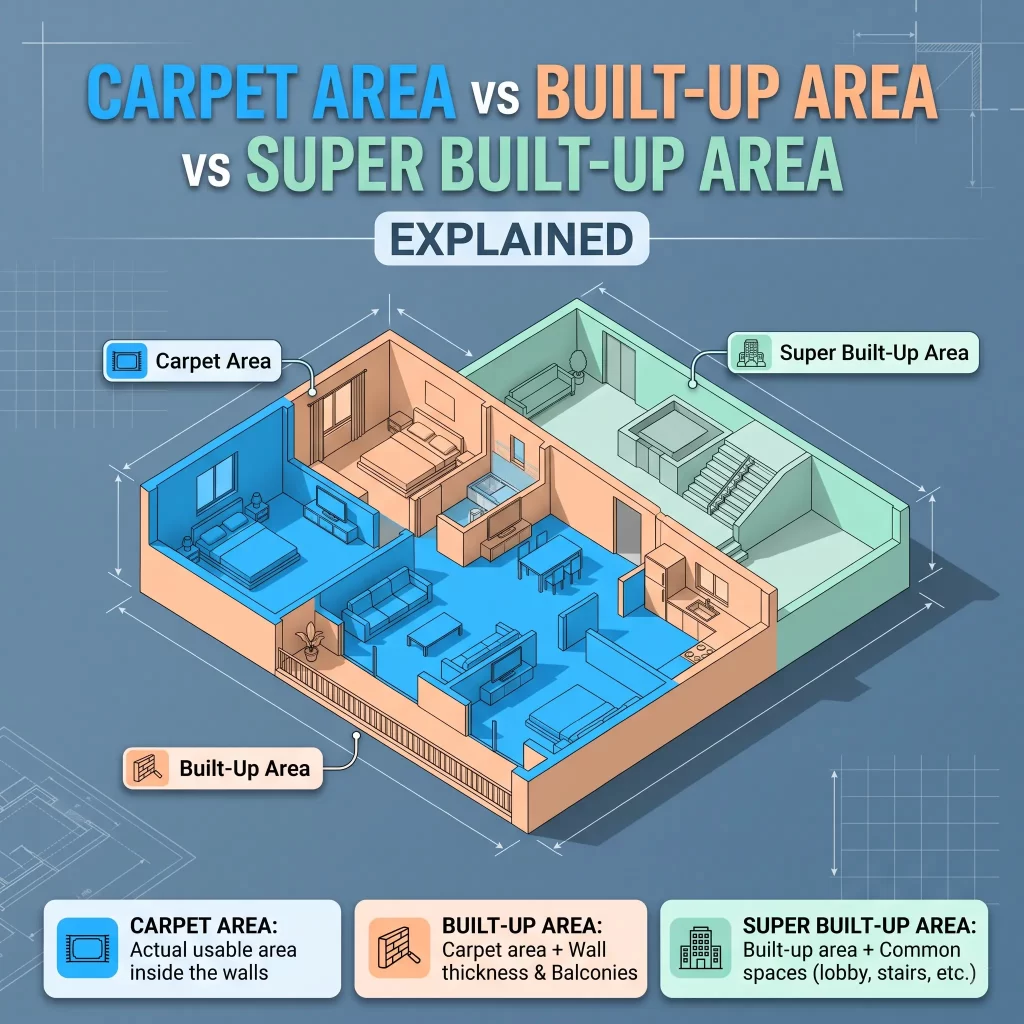
Carpet area is the actual usable floor space inside the apartment. In other words, it is the area on which you can literally roll out a carpet. It includes bedrooms, living room, kitchen, bathrooms, balconies, and internal partition walls. However, it excludes the thickness of external walls, common areas, lift lobbies, and ducts. RERA defines carpet area as the net usable floor area of an apartment. This excludes external walls, service shafts, exclusive balcony/verandah area, and exclusive open terrace area.
This is the number that matters most. After all, this is the space you actually live in. If you are examining apartment carpet area in Bangalore, expect it to be roughly 70% of the super built-up area in older projects. In premium high-rises, it shrinks to 60–65% because lobbies and amenities eat into your share. At MNM Enterprises, every project brochure clearly displays the carpet area alongside the super built-up figure. As a result, buyers never have to guess what they are paying for.
What Is Built-Up Area?
Beyond Carpet Area vs Built-Up Area: Walls and Balconies
Built-up area is the carpet area plus the thickness of external walls, internal partition walls, and the balcony/terrace attached to the apartment. In simple terms, it is the area enclosed by the apartment’s outer boundary. Typically, built-up area is 10–15% larger than the carpet area.
For example, if an apartment has a carpet area of 700 sq ft, its built-up area may be around 820 sq ft. Many developers quote built-up area to make the apartment appear larger. Nevertheless, RERA now mandates that pricing must be based on carpet area, not built-up or super built-up. This is one of the most important points in the Carpet Area vs Built-Up Area debate. Simply put, what you see on the brochure is not always what you pay for.
What Is Super Built-Up Area?
Where Carpet Area vs Built-Up Area Meets Common Amenities
Super built-up area is the built-up area plus a proportionate share of common areas. These include lift lobbies, staircases, clubhouses, corridors, gymnasiums, swimming pools, security cabins, and other shared amenities. This is the figure most aggressively marketed as the “saleable area.” Consequently, it can be 25–40% larger than the carpet area, depending on the project’s amenity load.
The proportion added is called the loading factor. For instance, if a builder quotes 1200 sq ft super built-up with 30% loading, the actual carpet area is around 840 sq ft. This is exactly why Carpet Area vs Built-Up Area discussions almost always circle back to super built-up area. Ultimately, it is the figure that creates the biggest gap between expectation and reality for a buyer.
Carpet Area vs Built-Up Area: The Real Difference
Carpet Area vs Built-Up Area in Plain Numbers
Understanding Carpet Area vs Built-Up Area is the cornerstone of smart home-buying. Carpet area is the space you actually walk on, sleep in, and place your furniture. By contrast, built-up area is the carpet area plus the walls around it. Super built-up area, meanwhile, throws in everyone’s shared spaces too. When comparing Carpet Area vs Built-Up Area, the practical takeaway is simple. Ask for all three figures in writing, but base your buying decision on the carpet area alone.
Many first-time buyers confuse the three. As a result, they end up paying for amenities as if they were private living space. The Carpet Area vs Built-Up Area gap is where builders traditionally made their margin. They quoted a large super built-up number and a small loading percentage. Under RERA, this practice is no longer legal. Yet it still happens in non-RERA-registered plots, agricultural-layout conversions, and resale transactions where the original sale deed predates RERA enforcement. Therefore, when navigating these area measurements, the rule of thumb is simple. If a number looks too good for the price, ask what it actually includes. In addition, ask for it in writing, and ask for the RERA registration number that backs it up. A genuine builder will answer all three questions without hesitation. Conversely, a builder who hesitates is one you should walk away from.
How to Calculate Flat Area in Bangalore
Flat Size Calculation Bangalore Buyers Can Trust
Flat size calculation Bangalore buyers can trust begins with three simple formulas. Master these, and you will never again be fooled by a brochure that promises 1200 sq ft and delivers 820:
- Carpet Area = Net usable floor area (bedrooms, living, kitchen, bathrooms, internal partitions, balconies).
- Built-Up Area = Carpet Area + Wall thickness + Balcony + Exclusive terrace.
- Super Built-Up Area = Built-Up Area + Proportionate share of common areas.
To calculate the loading factor, use this formula: (Super Built-Up Area − Carpet Area) ÷ Carpet Area × 100. If the result exceeds 35%, the project has high loading. Therefore, you are paying heavily for shared amenities.
If you want to know how to calculate flat area in Bangalore, ask the builder for the RERA registration number first. Once you have it, visit the RERA Karnataka portal and look up the project. Then, verify the carpet area quoted in the sale agreement against the carpet area filed with RERA. Any mismatch is a red flag. At MNM Enterprises, our sales team walks every client through this calculation live, on a printed sheet, before the token amount changes hands.
RERA Carpet Area Bangalore: Legal Standards
RERA Carpet Area Bangalore Rules Every Buyer Must Know
Under the Karnataka RERA Act, every builder must disclose the carpet area in the sale agreement and the allotment letter. Pricing must be based on carpet area alone, not built-up or super built-up. If the actual carpet area at possession is less than promised, the builder must refund the difference at the agreed rate within 60 days. On the other hand, if it is more, the buyer pays the difference — but only if the contract permits and within a 3% tolerance band.
RERA carpet area Bangalore rules also forbid quoting the super built-up area as the headline number in advertisements. For Carpet area vs built-up area in Bangalore disputes, RERA is the first line of defense. Therefore, always verify the project’s RERA number on the K-RERA portal. In addition, read the sale deed carefully before signing. As a RERA-compliant construction company, MNM Enterprises includes a carpet area clause in every agreement. Furthermore, we provide buyers a measurement sheet post-completion.
Carpet Area of 2 BHK and 3 BHK Flats in Bangalore
Carpet Area of 2 BHK Flats in Bangalore
Typical carpet area of 2 BHK flats in Bangalore ranges from 600 sq ft in compact configurations to 900 sq ft in premium layouts. For instance, a standard 2 BHK in Whitefield, Electronic City, or Sarjapur Road will usually offer a carpet area of around 700–750 sq ft. This is comfortable for a family of three to four.
Carpet Area of 3 BHK Flats in Bangalore
For larger families, the carpet area of 3 BHK flats in Bangalore typically ranges from 950 sq ft to 1300 sq ft. Premium 3 BHKs in locales like Indiranagar, Koramangala, or Hebbal can cross 1500 sq ft of carpet area. This is especially true in low-density projects with larger balconies and decks. Always verify these numbers against the RERA filing, not just the marketing brochure.
When comparing configurations across projects, remember that 2 BHKs generally have slightly higher loading. The reason is that kitchens and bathrooms require proportionate plumbing shafts. At MNM Enterprises, our 2 BHK and 3 BHK configurations are designed to maximise carpet area. As a result, we typically deliver 70–75% efficiency, well above the Bangalore average of 60–65%.
Smart Tips for Buying an Apartment in Bangalore
Carpet Area vs Built-Up Area: A Buyer’s Checklist
- First, always ask for the carpet area, built-up area, and super built-up area in writing — not just verbally.
- Second, verify the project’s RERA registration number on the K-RERA portal.
- Third, read the sale agreement’s carpet area clause carefully; it is legally binding.
- Next, insist on a post-possession measurement sheet from the builder.
- Then, compare loading factors across at least three projects before deciding.
- Finally, work only with RERA-compliant builders like MNM Enterprises.
Buying an apartment in Bangalore is one of the biggest financial decisions you will make. For example, a 5% difference in carpet area on a 1200 sq ft super built-up flat is roughly 60 sq ft of usable living space. That is equivalent to a small study or a spacious walk-in wardrobe. Therefore, never let glossy brochures substitute for hard numbers.
Why Choose MNM Enterprises?
Carpet Area vs Built-Up Area, Done Right
MNM Enterprises is a Bangalore-based construction company known for transparent flat size calculation Bangalore buyers can verify independently. From RERA-compliant residential projects to premium villas and commercial spaces, we put carpet area first — in our brochures, in our agreements, and in our delivery. Moreover, our team helps you understand every measurement before you commit a single rupee. Equally important, our project managers walk you through every square foot at handover. When you book with MNM Enterprises, you book clarity, compliance, and construction quality you can stand on.
Frequently Asked Questions (FAQs)
These FAQs address the most common search intents around carpet area, built-up area, and super built-up area in Bangalore real estate.
Q. What is the difference between carpet area and built-up area?
A. Carpet area is the actual usable floor space inside your apartment, including bedrooms, living room, kitchen, bathrooms, and balconies. Built-up area is the carpet area plus the thickness of internal and external walls, balconies, and exclusive terraces. Therefore, the carpet area is always smaller than the built-up area.
Q. Why is the super built-up area higher than carpet area?
A. Because a super built-up area adds a proportionate share of common areas like lobbies, staircases, lifts, clubhouses, and amenities. Hence, it is also called the saleable area. The gap between super built-up and carpet area is the loading factor — typically 25–40% in Bangalore apartments.
Q. What is the RERA rule for carpet areas in Bangalore?
A. RERA mandates that all apartment pricing be based on carpet area, not super built-up. Builders must disclose carpet area in the agreement and refund any shortfall at possession within 60 days. The tolerance band for variation is 3%.
Q. How can I verify the carpet area before buying a flat?
A. First, check the project’s RERA registration on the K-RERA portal. Then, ask the builder for a measurement sheet, and cross-verify with an independent architect or site visit. Reputable builders like MNM Enterprises provide this documentation before booking.
Q. What is the typical carpet area of 2 BHK flats in Bangalore?
A. Most 2 BHK flats in Bangalore offer a carpet area between 600 sq ft and 900 sq ft, depending on location and project tier. Standard mid-segment 2 BHKs deliver around 700–750 sq ft of carpet area.
Q. What is the typical carpet area of 3 BHK flats in Bangalore?
A. Most 3 BHK flats in Bangalore offer a carpet area between 950 sq ft and 1300 sq ft. Premium projects in Indiranagar, Koramangala, and Hebbal go up to 1500 sq ft or more.
Q. What is a good loading factor in Bangalore apartments?
A. A loading factor of 25–30% is considered acceptable. Anything above 35% means you are paying heavily for shared spaces instead of usable living areas. Therefore, always compare loading across at least three projects.
Q. How does MNM Enterprises ensure transparent flat size calculation in Bangalore?
A. We disclose carpet area, built-up area, and super built-up area on every brochure, include a carpet area clause in every agreement, and provide a post-possession measurement sheet. As a result, our projects deliver 70–75% carpet area efficiency — well above the Bangalore average.
For More Visit : https://mnmenterprises.ltd
Looking to buy flats in bangalore contact : https://www.globesproperties.com