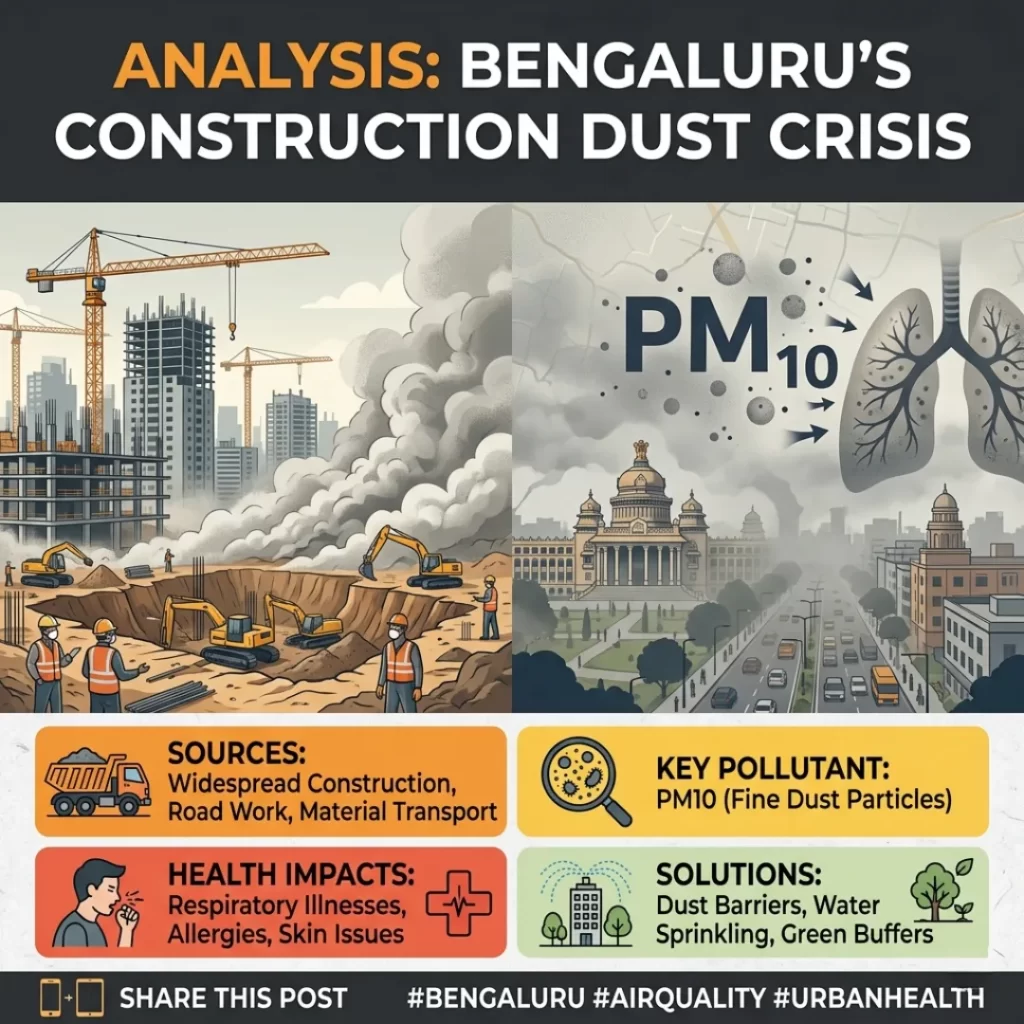
Let’s take a moment and be brutally honest about something that has been creeping up on us. Do you remember the old Bengaluru? The city where stepping out for a morning walk meant breathing in air so fresh it felt like a privilege? The city proudly wore the title of the “Garden City,” where the weather was the stuff of legends and the air stayed perpetually clean. Fast forward to today, and that reality feels like a fading dream.
If you step outside right now, especially in areas experiencing a real estate boom, you won’t smell the rain or the flowers. Instead, you’ll taste grit. You’ll feel that dry, scratchy sensation at the back of your throat. You’ll wipe a layer of fine, grey powder off your scooter seat every single morning. We are living in a city that is quite literally choking on its own growth.
The headline we are analyzing today—“Bengaluru Faces Air Quality Issues Due to Construction Dust”—is not just a news flash. It is our daily reality. It is the silent crisis that is affecting our health, our children, and our overall quality of life. And as someone deeply embedded in this industry through MNM Enterprises, I can tell you that we can no longer sweep this problem under the rug. Or rather, we can no longer let it blow into our living rooms.
Decoding the Title: What Does “Air Quality Issues” Really Mean?
When we read the phrase “Air Quality Issues,” it sounds very clinical, doesn’t it? It sounds like a statistic on a government dashboard. But for the residents of Bengaluru, it translates into a very painful, very human experience.
Bengaluru Air Pollution is no longer a distant threat; it is a present danger. For years, we consoled ourselves by comparing our air to Delhi’s toxic smog. We said, “At least we aren’t as bad as the north.” But that complacency is hurting us. The Air Quality Index (AQI) in several parts of our city has consistently hit “Poor” and “Very Poor” marks, especially during the dry months.
The Reality of Poor Air Quality Bengaluru
Poor Air Quality Bengaluru is a reality that hits you when you realize you can no longer see the skyline clearly from Nandi Hills. It hits you when the beautiful silhouettes of our beloved skyline stay permanently shrouded in a brownish-grey haze. It is the reality of walking into your home and realizing your freshly mopped floor gathers dust again within hours. The “issues” the title speaks of are not just inconveniences; they represent a fundamental degradation of the environment that made this city so desirable in the first place.
The Culprit Unmasked: The Invisible Cloud of Dust
The title specifically points the finger at “Construction Dust.” This is the crux of the matter. Bengaluru is one of the fastest-growing metropolises in the world. The IT boom brought an influx of people, and those people need homes, offices, and infrastructure. The result? Cranes and scaffolding define our city’s skyline. From Whitefield to Electronic City, from Hennur to Sarjapur, construction sites dominate the landscape.
But all this progress comes with a heavy price. Construction Dust in Bengaluru [1] has become the primary antagonist in our fight for clean air. What exactly is this dust? It is a toxic cocktail of particulate matter. When earthmovers dig into the red soil of Bengaluru, when workers mix concrete, when laborers cut bricks, and when trucks haul away debris, they release millions of microscopic particles into the air.
The Danger of Dust Pollution from Construction Sites
We are talking about PM10 (particles with a diameter of 10 micrometers or less) and the far more dangerous PM2.5 (particles 2.5 micrometers or less). These particles are so tiny that they bypass our body’s natural defenses—the hair in our noses, the mucus in our throats—and lodge themselves deep into our lungs. Some even enter our bloodstream. The Dust Pollution from Construction Sites is not just dirt; it is a silent, invisible assassin.
The Real-World Impact: It’s Not Just Dirty Cars
Let’s move away from the science for a second and talk about the real human cost. The Environmental Impact of Construction Bengaluru is staggering, but the health impact is what should truly alarm us.
I talk to residents every day. I meet elderly couples who have lived in their homes for thirty years but can no longer open their windows because the construction next door triggers their asthma. I meet young parents who are terrified of letting their toddlers play in the garden because the air hangs thick with cement dust. Doctors report a massive spike in respiratory illnesses—chronic bronchitis, allergic rhinitis, and asthma. The constant inhalation of Construction Air Pollution Bengaluru is making our children sick and our elderly frail.
Furthermore, this dust carries heavy metals and toxic chemicals from cement, silica, and paint. When this dust settles on our cars, it creates an annoyance. But when we breathe it into our lungs, it creates a health hazard. Urban Pollution in Bengaluru has reached a tipping point, and construction dust leads the charge.
The Root of the Problem: Why is it so Bad?
You might ask, “Construction happens all over the world. Why is it so terrible in Bengaluru?” The answer lies in how builders have historically managed construction in our city.
The primary issue is a complete disregard for Construction Site Dust Control. For decades, the standard operating procedure for a construction site in Bengaluru has been: dig, build, and let the dust settle wherever it may.
The Complete Disregard for Construction Site Dust Control
1. Uncovered Debris and Open Trucks If you drive on any of our ring roads, you will inevitably find yourself behind a truck carrying construction debris or sand. Nine times out of ten, the load sits completely uncovered. As the truck speeds down the road, it leaves a massive trail of dust and sand in its wake. By the time it reaches its destination, a significant portion of its load has deposited onto the streets and into the lungs of the city.
2. Dry Construction Sites Water is the most basic tool for suppressing dust. But many sites in Bengaluru operate with bone-dry floors. When workers mix cement, or when machines move earth, the lack of water spraying means the dust instantly becomes airborne.
3. No Boundary Walls or Green Mesh Many smaller sites operate without proper hoardings or mesh covers. The wind blows right through the site, carrying fine cement and soil particles straight into neighboring homes and apartments.
4. Unregulated Material Cutting Cutting marble, granite, and bricks on-site without wet-cutting techniques or dust extraction systems creates dense clouds of silica dust. This is not just a nuisance; it poses a severe occupational hazard for the workers and a neighborhood hazard for the residents.
The sheer volume of Construction Dust in Bengaluru [2] stems from treating the environment as an afterthought. Builders often think their responsibility ends at the boundary of their site, ignoring the community they are building within.
The Solution: It’s Time to Clean Up Our Act
The situation seems dire, but we can still fix it. We do not have to choose between urban development and clean air. We can have our modern infrastructure and breathe easily too. But this requires a massive shift in mindset and a strict adherence to Construction Site Dust Control measures.
As an industry, we need to stop making excuses and start implementing basic, common-sense practices.
Practical Steps for Construction Site Dust Control
1. Water Sprinkling and Wet Cutting This is the easiest and most effective step. Sites must have a dedicated water sprinkling system. Workers must keep the ground damp, especially during excavation and debris clearance. When cutting stones or tiles, wet-cutting methods must be mandatory. The water binds the dust, preventing it from becoming airborne.
2. Covering Materials and Debris Every single truck leaving a construction site must have a secure tarpaulin covering its load. There should be zero tolerance for open trucks. Similarly, on-site sand and aggregates should sit under covers or within enclosed bays to prevent wind erosion.
3. Dust Screens and Green Mesh The periphery of every construction site must feature a wrap of high-quality dust screens or green mesh. This acts as a physical barrier, trapping the dust inside the site. It is a simple, inexpensive tool that can reduce the migration of dust to neighboring properties by over 50%.
4. Wheel Wash Stations Before any vehicle leaves a site, workers should wash its wheels down to remove mud and dust. This prevents the dirt from tracking onto public roads, where it dries up and turns into airborne particulate matter.
5. Real-Time Air Quality Monitoring Modern construction sites should equip their boundaries with real-time air quality monitors. If the PM2.5 and PM10 levels cross a certain threshold, work should pause, and suppression measures should ramp up. This brings accountability to the process.
The MNM Enterprises Promise: Building a Cleaner Tomorrow
Now, let me step down from the soapbox and speak to you directly as a representative of MNM Enterprises. We are a construction company. We build homes, we dig foundations, and we pour concrete. But we also live in this city. We breathe this air. Our children go to schools here. And we are absolutely sick of the bad reputation our industry has earned due to the carelessness of a few.
When we formed MNM Enterprises, we made a conscious decision to do things differently. We looked at the rampant Construction Dust in Bengaluru [3] and decided we would not be part of the problem. We committed to responsible, eco-friendly construction practices that respect not just the client, but the entire neighborhood.
We understand that the Dust Pollution from Construction Sites causes major trauma for the community. That is why we have integrated stringent anti-pollution measures into our core operational protocol. It is not an afterthought for us; it is the foundation of how we build.
At MNM Enterprises, heavy-duty dust mesh encloses every one of our sites. We enforce strict water sprinkling schedules, ensuring our sites never stay bone-dry. We mandate wet-cutting for all masonry and stone work. We ensure that workers securely tarp every truck carrying sand or debris leaving our site. We do this not because the government forces us to, but because it is the right thing to do.
We believe that delivering a beautiful, high-quality home to a client means nothing if we leave the surrounding community gasping for air. Our reputation builds on trust, and that trust extends to the neighbors who have to live next to our sites. When you build with MNM Enterprises, you choose a partner who cares about the air your family breathes, even before we put on the roof.
The Regulatory Push: Will Stricter Rules Help?
While responsible builders like us try to set a standard, we cannot rely on goodwill alone to fix this crisis. The government and civic bodies must step up. The BBMP and the Karnataka State Pollution Control Board (KSPCB) have guidelines, but enforcement remains notoriously weak.
Authorities set fines for violating dust control norms so low that many builders simply pay them off as a cost of doing business. This needs to change. We need hefty penalties that make it financially unviable for builders to ignore Construction Site Dust Control.
Furthermore, the government must tie building plan approvals directly to strict environmental compliance. If officials find a site violating air quality norms, they must halt construction immediately until the builder takes corrective measures. The threat of a stop-work order is the only language reckless builders understand.
The Environmental Impact of Construction Bengaluru is too severe to leave to self-regulation alone. Citizens must also actively complain and report sites that cause excessive dust. We have a right to breathe clean air, and we must demand it.
The Long Road to Recovery: Clearing the Air
The title “Bengaluru Faces Air Quality Issues Due to Construction Dust” should serve as a wake-up call for every stakeholder in this city. We cannot afford to normalize waking up to a dusty haze. We cannot accept asthma and allergies as the price of urbanization.
The Poor Air Quality Bengaluru is experiencing is a man-made disaster, which means we have the power to fix it entirely. It requires builders to stop being negligent. It requires the government to enforce laws strictly. And it requires citizens to demand better.
At MNM Enterprises, we are doing our part. We prove every day that you can build world-class structures without choking the neighborhood. We show that Construction Air Pollution Bengaluru can mitigate if there is a will to do so.
But we are just one company. The industry as a whole needs to evolve. The next time you see an uncovered truck spilling sand on the road, or a site blasting dust into a neighbor’s window, speak up. The next time you plan to build your dream home, choose a builder who respects the environment as much as they respect your budget.
Let’s reclaim our Garden City. Let’s demand construction practices that build homes, not respiratory diseases. Let’s clear the air, one responsible brick at a time. Because the legacy we leave for our children shouldn’t just measure the buildings we construct, but the air they are forced to breathe.
Construction Dust in Bengaluru [4] is a crisis, yes. But it is a crisis we can defeat if we stop turning a blind eye. Let’s build better. Let’s build cleaner. And let’s make Bengaluru breathe again.
Beyond the Dust: A Deeper Look at Our Urban Future
When we talk about the dust, we are really talking about the soul of our city. Bengaluru was once a city of lakes and gardens. The transformation into a concrete jungle happened so rapidly that we didn’t have time to put the necessary safeguards in place. We are now paying the price for that haphazard growth.
Think about the micro-climate of the city. The Urban Pollution in Bengaluru isn’t just about the dust you see; it’s about the heat island effect created by endless concrete, the loss of tree cover, and the drying up of lakes. Construction dust is the most visible symptom of this deeper malaise.
The Vicious Cycle of Urban Pollution in Bengaluru
When workers strip away topsoil for a foundation, it doesn’t just disappear. If left unmanaged, it dries out and becomes the very dust that coats our lungs. When builders fell trees to make way for high-rises, we lose the natural air purifiers that could have filtered out the Construction Dust in Bengaluru [5]. It is a vicious cycle. We destroy nature to build, and the lack of nature makes the pollution worse.
This is why the philosophy at MNM Enterprises goes beyond just on-site dust control. We advocate for and implement green building practices. We try to preserve existing trees on our plots wherever possible. We use sustainable materials that generate less particulate waste. We plan our logistics to minimize the number of truck trips to and from the site, thereby reducing the Dust Pollution from Construction Sites as well as vehicular emissions.
The Economic Cost of Dirty Air
We often discuss the health costs, but what about the economic cost? Bengaluru Air Pollution has a direct impact on our economy. Increased healthcare costs, lost productivity due to illness, and a decrease in the overall quality of life all hit our wallets hard.
Furthermore, dirty air drives away talent. Bengaluru’s growth is fueled by the IT sector and global professionals. If the city’s air becomes unbreathable, companies will struggle to attract top talent. Expatriates and skilled workers will choose cleaner cities over a polluted tech hub. The very economic engine that sparked this construction boom could stall because of the pollution it creates.
How Bengaluru Air Pollution Hurts Our Economy
Real estate values in highly polluted corridors are already taking a hit. People will pay a premium for homes in areas with better air quality and green cover. As a builder, ignoring Construction Site Dust Control is not just unethical; it is bad for business in the long run. A reputation for dirty, polluting sites will eventually drive discerning clients away.
Empowering the Citizen: What You Can Do
As a resident of Bengaluru, you are not helpless against this tide of dust. You can take practical steps to protect yourself and force the industry to change:
1. Report Violators: Use the KSPCB and BBMP helplines. If a site near you operates without dust covers, has open trucks, or causes severe air pollution, complain. Take photos and videos as proof. Public pressure works.
2. Protect Your Home: If you live next to a construction site, seal your windows and use air purifiers indoors. Grow dense, broad-leaved plants on your balconies; they act as natural dust catchers.
3. Demand Accountability: When you buy a property or hire a builder, ask them about their dust control policies. Ask to see their hoardings and water sprinkling arrangements. If they can’t give you a satisfactory answer, walk away.
The MNM Enterprises Standard: A Blueprint for the Future
We want to set a standard that becomes the blueprint for the future of construction in this city. We want the day to come when Construction Dust in Bengaluru [6] is a thing of the past, a relic of bad practices.
How do we get there? We must make the cost of pollution higher than the cost of prevention. At MNM Enterprises, we factor dust control into our project budgets from day one. We treat it as a non-negotiable line item. We train our site engineers and contractors not just on structural integrity, but on environmental compliance. We conduct surprise audits to ensure that the mesh stays up, the water flows, and workers cover the trucks.
We believe that we must mitigate the Environmental Impact of Construction Bengaluru at the source. You cannot build first and clean up later; the damage is already done. Prevention is the only cure.
A Collective Responsibility
Let’s revisit that title one last time: “Bengaluru Faces Air Quality Issues Due to Construction Dust.” It is a statement of fact, but it should also serve as a call to action.
The government must tighten the screws. Citizens must raise their voices. And the construction industry must look in the mirror and commit to change.
We cannot stop building. People need homes, and the city needs infrastructure. But we must build responsibly. We must recognize that the air we share holds more value than the speed at which we can pour concrete.
At MNM Enterprises, we commit to this vision. We are proud to build the homes of your dreams, but we are even prouder to do it in a way that lets you, and your neighbors, breathe easy.
Let’s not let Construction Dust in Bengaluru [7] steal our city’s charm. Let’s build a future where progress and purity coexist. Because a home isn’t truly a sanctuary if the air outside its walls is poison.
Together, let’s clean up our act. Let’s champion Construction Site Dust Control not as a regulatory burden, but as a moral duty. The Garden City can bloom again, but only if we stop choking it with dust. Choose responsible builders. Choose clean air. Choose MNM Enterprises. Let’s build a Bengaluru we can all be proud to breathe in, today and for generations to come. The fight against Construction Dust in Bengaluru [8] starts right here, right now, with all of us.
For More Visit: https://mnmenterprises.ltd/
If you are planning to buy flats contact : https://globesproperties.com/