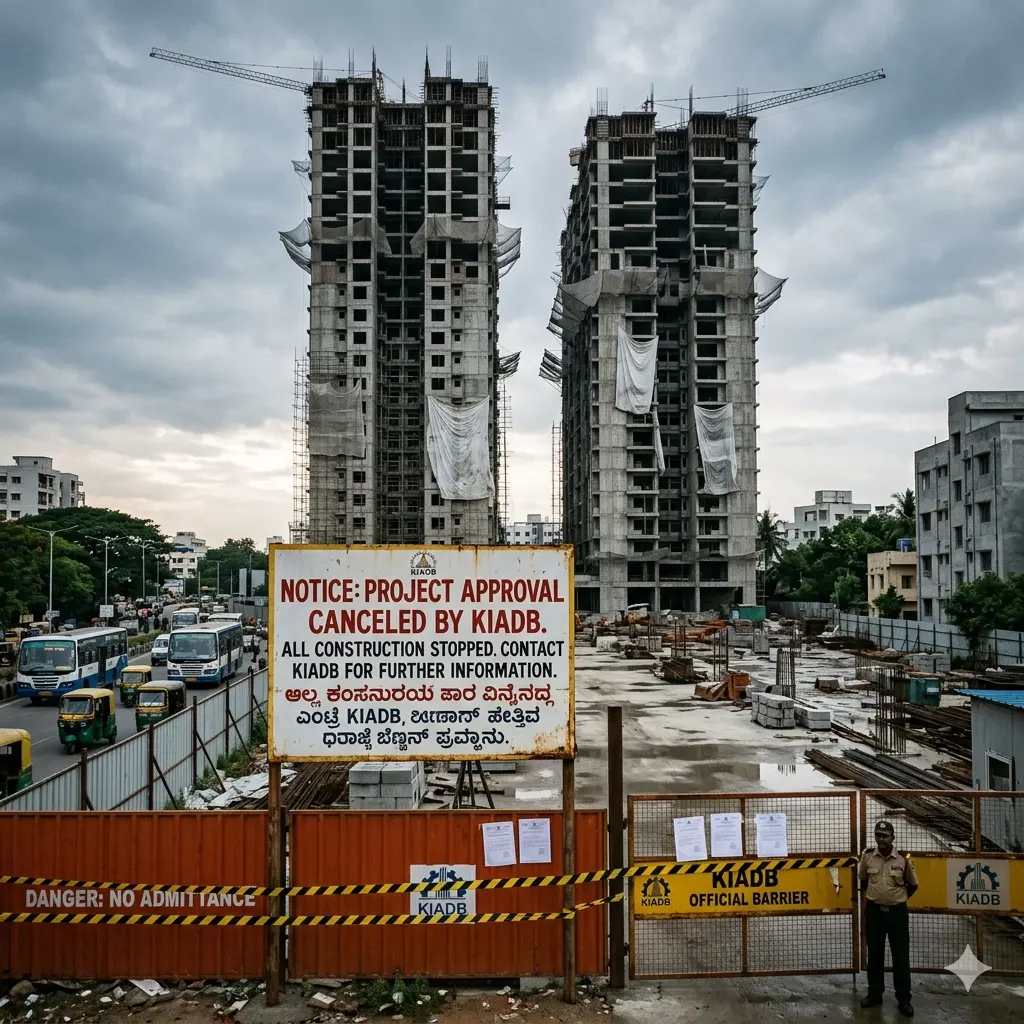
If you have been keeping an eye on the property market lately, you probably saw the headlines that sent a shiver down the spines of homebuyers and developers alike. A major Bengaluru high-rise project is currently facing the axe, with the authorities moving toward a drastic KIADB approval cancellation. For the hundreds of prospective homeowners who had booked their dream flats in this tower, this isn’t just a news headline; it’s a waking nightmare. Their life savings suddenly hang in limbo, and the trust they placed in a builder has vanished into thin air.
Let’s be brutally honest here: buying a home in Bengaluru is not a walk in the park. It takes years of saving, compromising on daily luxuries, and navigating a dizzying maze of paperwork. So, when you hear that a project you invested in has hit a regulatory wall this massive, it’s absolutely terrifying. But how does something like this even happen? What allows a massive, multi-crore high-rise to get off the ground only to lose its permissions?
To understand this, we need to peel back the layers of Bengaluru real estate news and look at the complex, often messy world of land usage, zoning laws, and regulatory oversight. Let’s dive deep into what this recent crisis means for the city, the buyers, and the future of Urban development Bengaluru.
Understanding the Beast: What is KIADB?
Before we can grasp the gravity of a cancellation, we need to understand the body that holds the power. KIADB stands for the Karnataka industrial area development board. The government established it with a very specific mandate: to acquire land and develop infrastructure for industries in the state. Think of them as the custodians of Karnataka’s industrial future. They create industrial parks, set up special economic zones (SEZs), and ensure that manufacturing and tech companies have the land and infrastructure they need to operate.
But here is where the water gets murky. In a rapidly expanding city like Bengaluru, the lines between “industrial” and “residential” have blurred significantly. Tech parks sit right next to residential apartments, cafes, and malls. Developers, seeing the massive demand for housing near these employment hubs, often try to build residential projects on or adjacent to KIADB-allotted lands. They attempt this through loopholes, re-zoning applications, or joint ventures.
When a builder wants to construct a residential high-rise on land that falls under KIADB’s jurisdiction, they must obtain explicit KIADB project approval. This is not a simple formality. The developer must prove that the authorities have legally converted the land use, that the infrastructure can support a massive residential population, and that the project aligns with the broader industrial and urban planning goals of the region.
The Anatomy of a Cancellation: How Did We Get Here?
So, why does a KIADB project approval get canceled? It usually doesn’t happen overnight. Rather, it’s the culmination of red flags, ignored rules, and eventually, the law catching up.
In the case of this recent Bengaluru high-rise project, the roots of the problem lie in the messy intersection of land conversion and zoning violations. When KIADB allots land, it strictly restricts it to industrial or allied purposes. If a developer decides to build luxury apartments on land that still technically carries an industrial designation, or if they have only received partial, conditional approval, they are playing a very dangerous game.
One of the most common High-rise building approval issues in these scenarios involves developers constructing far beyond what they initially sanctioned. A developer might get approval for a smaller structure or a different type of building, and then quietly revise the plans to build a towering residential complex. They bank on the fact that by the time the authorities notice, the building will stand as a fait accompli—too big and too expensive to demolish.
However, regulatory bodies have started pushing back hard. The KIADB approval cancellation we are seeing today sends a stark message: the government will not tolerate the misuse of industrial land for unauthorized residential gain. Whether a builder encroaches on buffer zones, violates floor area ratios (FAR), or flat-out ignores the stipulated land use, the consequences are now severe.
The Ripple Effect: Who Really Pays the Price?
When the media broadcasts an Apartment project approval news disaster, the developer’s reputation takes a hit, sure. But the real victims are the homebuyers. Imagine being an IT professional who has taken a 20-year loan, paid stamp duty, and eagerly awaits possession, only to discover the authorities might demolish or stall your project indefinitely.
The emotional toll is immense. Families argue, sleep vanishes, and the dream of owning a home transforms into a financial trap. Legally, the buyers find themselves stuck in a quagmire. They can approach the Real Estate Regulatory Authority (RERA), but recovering money from a developer whose project just collapsed is a long, arduous battle. The funds of the project often tie up in construction costs, leaving very little for refunds.
This is exactly why Real estate regulations Karnataka exist in such stringent form. They aren’t just bureaucratic hoops to jump through; they form the only safety net protecting the consumer. When a builder bypasses the system to secure a KIADB project approval through questionable means, they essentially gamble with the life savings of ordinary people.
The Bigger Picture: Bangalore Infrastructure Development at a Crossroads
Bengaluru is a city that perpetually finds itself in a state of construction. Cranes dot the skyline, and the sound of cement mixers provides the background noise of our lives. Yet, the chaotic growth of the city stems directly from the tension between demand and planning.
Historically, Bangalore infrastructure development has struggled to keep pace with the massive influx of population. The tech boom brought millions of people to the city, creating an insatiable demand for housing near employment hubs. This led to the vertical growth of the city—high-rises popping up in every available nook and cranny.
However, Urban development Bengaluru cannot just revolve around building tall buildings. It requires a holistic approach. Can the existing roads handle the traffic from a 50-story tower? Is there enough water? Can the sewage system cope? When KIADB designates land for industry, it often does so because the surrounding infrastructure suits commercial, not residential, density. Plonking a massive apartment complex in the middle of an industrial zone throws the entire ecosystem out of balance, leading to traffic gridlocks, water shortages, and infrastructural collapse.
Canceling this high-rise project is a painful but necessary step toward enforcing some discipline in the city’s growth. It serves as a wake-up call that land use regulations exist for a reason, and treating them as mere suggestions will no longer fly.
The Developer’s Dilemma vs. The Buyer’s Right
From a developer’s perspective, the pressure to deliver projects quickly and profitably is immense. Land in central Bengaluru costs an absolute fortune. To make a project financially viable, developers often need to build vertically, maximizing the number of units on a given plot. This financial pressure can sometimes lead to cut corners, especially regarding the complicated process of securing a KIADB project approval.
Some developers might start construction based on preliminary approvals, assuming the final clearances will come through eventually. Others might deliberately misrepresent the nature of their project to secure industrial land at cheaper rates, intending to convert it to residential use later.
But the era of such leniency is over. The authorities now use advanced satellite imagery and stricter audit processes to track construction in real-time. If a builder deviates from the sanctioned plan, officials will spot it, and the repercussions will be immediate.
For the buyer, the lesson is clear but harsh: caveat emptor, or buyer beware. You cannot simply rely on the builder’s marketing brochures or the shiny model apartment. Buyers have to dig deep into the legal status of the land and the validity of the approvals.
Navigating Construction Project Updates Bangalore
Staying informed is your best defense. If you are investing in an under-construction property, you shouldn’t just visit the site to see how high the walls have gone. Instead, actively track Construction project updates Bangalore through official channels, not just the developer’s WhatsApp group.
Check the RERA website regularly. Ensure that the project carries valid registration and that the developer files quarterly updates on time. If you notice long periods of inactivity or if the developer avoids giving you straight answers about specific approvals, those are massive red flags.
Specifically, if you are buying into a project located near an industrial area, a tech park, or a KIADB layout, you must demand to see the KIADB project approval documents. Do not accept “it’s being processed” as an answer after you have already handed over your hard-earned money. An approval that is “almost there” legally does not exist.
The Danger of Unauthorized High-Rise Building Approval Issues
Let’s talk about what happens when builders ignore these High-rise building approval issues. When someone constructs a building without proper clearances, the law considers it an illegal structure. Without a valid KIADB project approval, any residential construction on that land is essentially unauthorized, and the authorities have the right to issue a demolition notice. Even if the builder manages to secure a stay order from the court, the project enters a legal purgatory that can last decades.
During this time, the building cannot receive basic municipal amenities. You might not get a proper water connection, electricity might remain temporary and erratic, and you will certainly not be able to register the property in your name. Reselling such a property is nearly impossible, leaving the buyer stuck with an asset that holds no legal market value.
The recent KIADB approval cancellation presents a textbook example of this worst-case scenario unfolding. It highlights the absolute necessity of due diligence, not just for the homebuyer, but for the entire real estate ecosystem in the city.
How to Protect Yourself: A Homebuyer’s Checklist
If you are in the market for a new home, don’t let this news paralyze you. Let it empower you instead. Here are the critical steps you must take before signing on the dotted line:
- Verify the Land Use: Ensure the authorities have designated the land for residential use. If it is a KIADB plot, verify that the de-notification or conversion to residential use stands complete and legally binding.
- Check for KIADB Project Approval: If the project falls under KIADB jurisdiction, ask the developer for the explicit approval letter. Cross-verify this document directly with the KIADB office.
- RERA Registration: Never buy a project that lacks RERA registration. Read the RERA filings carefully; developers must legally declare any pending litigation or approval issues there.
- Title Deed Scrutiny: Hire an independent real estate lawyer to examine the title deed. Do not rely on the builder’s in-house legal team. Your lawyer should check for encumbrances, liens, and the history of the land ownership.
- Demand Commencement Certificates: A Commencement Certificate (CC) from the municipal corporation proves that the builder has secured all the necessary permissions to start digging the foundation. Without it, the construction is illegal.
Introducing MNM Enterprises: Building on a Foundation of Trust
When the market floods with news of cancellations, stalled projects, and legal battles, it’s natural to feel cynical about the entire real estate industry. You might wonder if any builders still value ethics over easy profits. Are there companies that still believe in doing things the right way, even if it takes longer and costs more?
There absolutely are. And that is exactly why MNM Enterprises exists.
At MNM Enterprises, we are not just a construction company; we are custodians of your trust. We watched as the Bengaluru real estate news cycle became dominated by stories of cut corners and broken dreams, and we made a conscious decision to be the antidote to that toxicity. Our core belief is that the foundation of any great building isn’t just concrete and steel—it is integrity, transparency, and an unwavering commitment to the law.
When you partner with MNM Enterprises for your dream home, you choose a builder who understands the intricate dance of Real estate regulations Karnataka. We don’t look for loopholes. Gambling with your savings is completely against our ethos. We firmly believe that if a project cannot be built legally and ethically, it should not be built at all.
The MNM Difference: Zero Compromise on Approvals
Let’s talk about how we handle the dreaded “A” word—Approvals. We know that navigating the bureaucratic maze of the Karnataka industrial area development board, BDA, BBMP, and other regulatory bodies is complex. But we also know that it is non-negotiable. Securing a KIADB project approval is a rigorous process that separates ethical developers from the rest.
Before we even purchase a plot of land, our legal and compliance team conducts an exhaustive due diligence process. We trace the history of the land, verify the zoning, and ensure there are no hidden surprises. If a piece of land requires a KIADB project approval, we engage with the board transparently, submitting every required document and adhering strictly to their guidelines.
We refuse to start excavation until every single piece of paper carries the official stamp and seal. We maintain a strict zero-tolerance policy toward deviations. The plan we show you in our office is the exact plan we submit to the authorities. This means you will never have to wake up to the nightmare of an approval cancellation or a demolition notice. With MNM Enterprises, what you see is exactly what you get—a legally sound, beautifully crafted home.
Shaping the Future of Urban Development Bengaluru
At MNM Enterprises, we see ourselves as more than just builders; we are active participants in shaping this great city. We recognize that Bangalore infrastructure development stands at a critical juncture. The city desperately needs housing, but it needs housing that respects the urban plan.
By strictly adhering to zoning laws and land-use regulations, we do our part to ensure that neighborhoods grow sustainably. We never want to build a high-rise that chokes the local roads or drains the water supply. Instead, we want to build communities that enhance the fabric of the city. This commitment to responsible Urban development Bengaluru weaves into the DNA of every project we undertake.
Peace of Mind: The Ultimate Luxury
When you buy a home built by MNM Enterprises, you are buying more than square footage and amenities. Peace of mind comes standard. That means enjoying the freedom to focus on choosing paint colors and furniture, rather than worrying about court dates and legal notices.
We provide our clients with complete transparency. Every document, every approval—from environmental clearances to fire safety NOCs to the crucial KIADB project approval—is made available to you. We believe that an informed buyer is a confident buyer, and our job is to give you zero reasons to doubt your investment.
The Verdict: Choose Wisely, Build Securely
The recent news of a Bengaluru high-rise project facing a KIADB approval cancellation is a stark reminder of the risks lurking in the real estate market. It tells a story of ambition outpacing ethics, and the devastating consequences that follow when developers treat rules as optional.
But it doesn’t have to be your story.
The landscape of Apartment project approval news might seem scary, but it doesn’t have to paralyze you. By doing your due diligence, asking the right questions, and most importantly, choosing a builder with an unblemished track record, you can navigate this market safely.
At MNM Enterprises, we proudly stand apart. We can confidently say that we have never compromised on a regulation, never bent a rule for a quick buck, and never left a buyer in legal limbo. We build homes the old-fashioned way: with hard work, honest materials, and absolute respect for the law.
If you are looking to build your dream home or invest in a commercial space, don’t settle for anything less than absolute integrity. Choose MNM Enterprises. Let us turn your blueprints into reality, safely, legally, and beautifully. Because when you build with trust, you build for a lifetime.
For More Visit : https://mnmenterprises.ltd/
If you are planning to buy flats contact : http://www.globesproperties.com