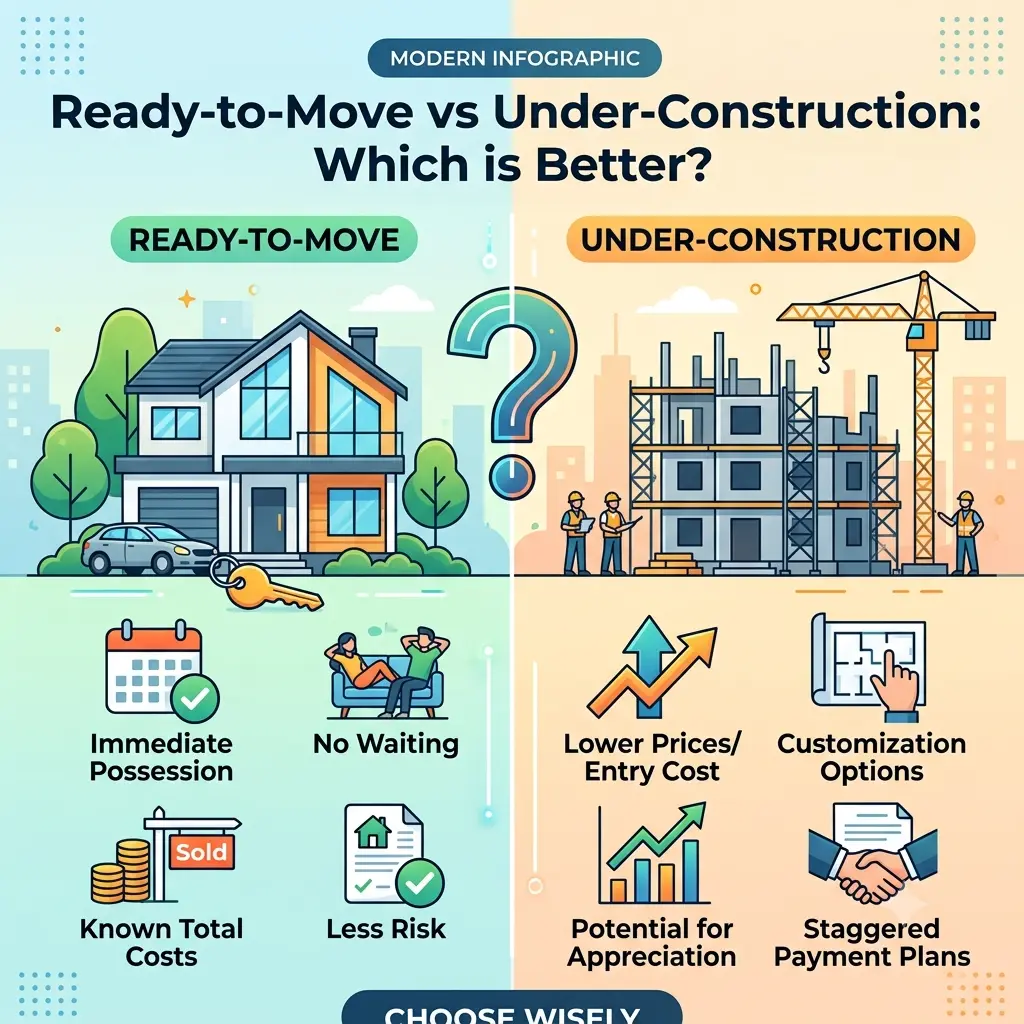
Ready-to-Move vs Under-Construction: Which is Better?
Buying a home is easily one of the most significant financial decisions you will ever make in your lifetime. Naturally, it is an emotional rollercoaster filled with excitement, anxiety, and endless questions. You work incredibly hard for years just to save up for that perfect down payment. Therefore, you want to make absolutely sure you put your hard-earned money in the right place. Right now, the biggest debate in the real estate world is Ready to Move vs Under Construction. Consequently, buyers constantly lose sleep trying to figure out which path is actually safer. Honestly, there is no single correct answer that applies to everyone. Instead, the right choice depends entirely on your personal financial situation, your timeline, and your risk appetite. Let us dive deep into this massive dilemma together. By the end of this comprehensive guide, you will know exactly what to do with your money. Understanding the Core Debate Before we compare the two options, we need to understand what they actually mean in practical terms. On one hand, a completed building gives you immediate possession. You pay the full price, get the keys, and move in next week. On the other hand, an upcoming project means you are buying a vision. The builder has just started digging the foundation, and you pay in small chunks over three or four years while the building slowly takes shape. Both options offer massive advantages to the buyer. However, both options also carry very specific risks. You just need to align those risks with your current life stage before signing the dotted line. The Appeal of a Ready to Move Property There is a certain undeniable magic in walking through an empty apartment and picturing your furniture there. Buying a Ready to Move Home eliminates the biggest fear in the Indian real estate market: builder delays. You do not have to cross your fingers and hope the project finishes on time. Essentially, what you see is exactly what you get. Furthermore, you can physically touch the walls, check the water pressure in the taps, and feel the breeze from the balcony. In addition, the neighborhood is already established around you. As a result, you know exactly what the traffic looks like during peak hours. You also know where the nearest grocery store is located. You can even talk to the current residents to find out if the maintenance team actually does a good job. Immediate Peace of Mind Mental peace is priceless in today’s fast-paced world. When you buy a completed flat, you are completely shielded from the possibility of the builder going bankrupt halfway through the construction. Moreover, you do not have to deal with the dust, noise, and chaos of an active construction site right outside your door. For families with young children or elderly parents, this immediate stability is absolutely essential. You can enroll your kids in nearby schools without worrying about shifting them again in two years. Ultimately, a Ready to Move Property provides a solid foundation for your family life. Eliminating the Rental Burden Ready to Move Flats are particularly perfect for people who are currently paying high rent. Nobody wants to pay rent and a home loan EMI at the same time if they can avoid it. With a completed flat, you stop paying rent immediately and move straight into your own asset. Consequently, your cash flow improves drastically from day one. Instead of making your landlord rich, you are building your own equity. Therefore, the relief of burning your rent agreement is a massive psychological benefit for most buyers. The Hidden Drawbacks of Immediate Possession However, buying a completed home is certainly not all sunshine and rainbows. The biggest hurdle is the massive upfront cost. You have to arrange the entire funds almost immediately to finalize the deal. There are no staggered payment plans to help you breathe financially. Banks will disburse the full loan amount at once, meaning your EMI starts immediately the very next month. The Upfront Financial Crunch Arranging a huge sum of money at once can drain your savings completely. Furthermore, you miss out on the opportunity to invest that money elsewhere for better returns. Because of this heavy initial financial hit, many middle-class families find themselves stretched too thin when opting for immediate possession. Therefore, you must carefully calculate your liquidity before choosing this route. Older Design Limitations Additionally, you are often buying an older design when you choose a completed project. Trends change rapidly in the interior design and architecture world. A flat that was designed five years ago might lack the smart home features, larger windows, or modular kitchen layouts that are standard today. Finally, you usually miss out on the initial price appreciation. The early investors already made their money by the time the building is finished. As a result, you are buying at the peak ready-to-move premium. The Magic of Buying an Under Construction Property Now, let us talk about why so many savvy investors absolutely love upcoming projects. Buying an Under Construction Property is fundamentally a wealth-building strategy. The biggest advantage is the significant price difference. Builders intentionally price the initial launch phases much lower to attract early buyers. As the building rises from the ground, the price steadily increases at every new phase. By the time you get the keys, the property value has usually appreciated by 20% to 30%. Literally, you make money while you sleep. Capital Appreciation Potential When evaluating the pros and cons of Ready to Move vs Under Construction, you must look closely at the financial angle. Real estate grows in value, but the maximum growth happens during the construction phase. If you buy a flat for 50 lakhs today, it might be worth 70 lakhs by the time it is finished in three years. You did not do any work, yet your net worth increased by 20 lakhs. Consequently, this makes upcoming projects incredible tools for wealth creation. Flexible Payment Plans Moreover, the payment plans for
Ready-to-Move vs Under-Construction: Which is Better? Read More »