Bengaluru Faces Air Quality Issues Due to Construction Dust
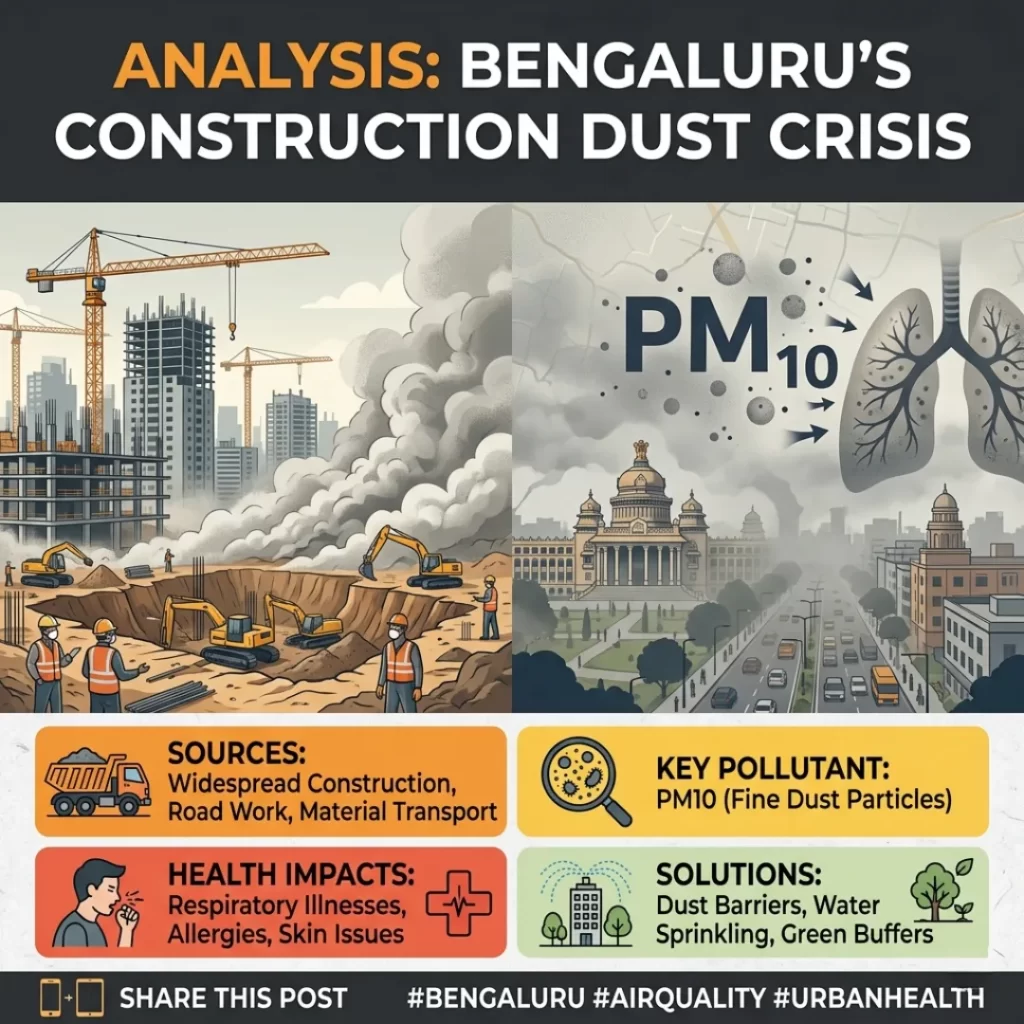
Let’s take a moment and be brutally honest about something that has been creeping up on us. Do you remember the old Bengaluru? The city where stepping out for a morning walk meant breathing in air so fresh it felt like a privilege? The city proudly wore the title of the “Garden City,” where the weather was the stuff of legends and the air stayed perpetually clean. Fast forward to today, and that reality feels like a fading dream. If you step outside right now, especially in areas experiencing a real estate boom, you won’t smell the rain or the flowers. Instead, you’ll taste grit. You’ll feel that dry, scratchy sensation at the back of your throat. You’ll wipe a layer of fine, grey powder off your scooter seat every single morning. We are living in a city that is quite literally choking on its own growth. The headline we are analyzing today—“Bengaluru Faces Air Quality Issues Due to Construction Dust”—is not just a news flash. It is our daily reality. It is the silent crisis that is affecting our health, our children, and our overall quality of life. And as someone deeply embedded in this industry through MNM Enterprises, I can tell you that we can no longer sweep this problem under the rug. Or rather, we can no longer let it blow into our living rooms. Decoding the Title: What Does “Air Quality Issues” Really Mean? When we read the phrase “Air Quality Issues,” it sounds very clinical, doesn’t it? It sounds like a statistic on a government dashboard. But for the residents of Bengaluru, it translates into a very painful, very human experience. Bengaluru Air Pollution is no longer a distant threat; it is a present danger. For years, we consoled ourselves by comparing our air to Delhi’s toxic smog. We said, “At least we aren’t as bad as the north.” But that complacency is hurting us. The Air Quality Index (AQI) in several parts of our city has consistently hit “Poor” and “Very Poor” marks, especially during the dry months. The Reality of Poor Air Quality Bengaluru Poor Air Quality Bengaluru is a reality that hits you when you realize you can no longer see the skyline clearly from Nandi Hills. It hits you when the beautiful silhouettes of our beloved skyline stay permanently shrouded in a brownish-grey haze. It is the reality of walking into your home and realizing your freshly mopped floor gathers dust again within hours. The “issues” the title speaks of are not just inconveniences; they represent a fundamental degradation of the environment that made this city so desirable in the first place. The Culprit Unmasked: The Invisible Cloud of Dust The title specifically points the finger at “Construction Dust.” This is the crux of the matter. Bengaluru is one of the fastest-growing metropolises in the world. The IT boom brought an influx of people, and those people need homes, offices, and infrastructure. The result? Cranes and scaffolding define our city’s skyline. From Whitefield to Electronic City, from Hennur to Sarjapur, construction sites dominate the landscape. But all this progress comes with a heavy price. Construction Dust in Bengaluru [1] has become the primary antagonist in our fight for clean air. What exactly is this dust? It is a toxic cocktail of particulate matter. When earthmovers dig into the red soil of Bengaluru, when workers mix concrete, when laborers cut bricks, and when trucks haul away debris, they release millions of microscopic particles into the air. The Danger of Dust Pollution from Construction Sites We are talking about PM10 (particles with a diameter of 10 micrometers or less) and the far more dangerous PM2.5 (particles 2.5 micrometers or less). These particles are so tiny that they bypass our body’s natural defenses—the hair in our noses, the mucus in our throats—and lodge themselves deep into our lungs. Some even enter our bloodstream. The Dust Pollution from Construction Sites is not just dirt; it is a silent, invisible assassin. The Real-World Impact: It’s Not Just Dirty Cars Let’s move away from the science for a second and talk about the real human cost. The Environmental Impact of Construction Bengaluru is staggering, but the health impact is what should truly alarm us. I talk to residents every day. I meet elderly couples who have lived in their homes for thirty years but can no longer open their windows because the construction next door triggers their asthma. I meet young parents who are terrified of letting their toddlers play in the garden because the air hangs thick with cement dust. Doctors report a massive spike in respiratory illnesses—chronic bronchitis, allergic rhinitis, and asthma. The constant inhalation of Construction Air Pollution Bengaluru is making our children sick and our elderly frail. Furthermore, this dust carries heavy metals and toxic chemicals from cement, silica, and paint. When this dust settles on our cars, it creates an annoyance. But when we breathe it into our lungs, it creates a health hazard. Urban Pollution in Bengaluru has reached a tipping point, and construction dust leads the charge. The Root of the Problem: Why is it so Bad? You might ask, “Construction happens all over the world. Why is it so terrible in Bengaluru?” The answer lies in how builders have historically managed construction in our city. The primary issue is a complete disregard for Construction Site Dust Control. For decades, the standard operating procedure for a construction site in Bengaluru has been: dig, build, and let the dust settle wherever it may. The Complete Disregard for Construction Site Dust Control 1. Uncovered Debris and Open Trucks If you drive on any of our ring roads, you will inevitably find yourself behind a truck carrying construction debris or sand. Nine times out of ten, the load sits completely uncovered. As the truck speeds down the road, it leaves a massive trail of dust and sand in its wake. By the time it reaches its destination, a significant portion of its
Bengaluru Faces Air Quality Issues Due to Construction Dust Read More »